Zoological classification : a handy book of reference with tables of the subkingdoms, classes, orders, etc., of the animal kingdom, their characters and lists of the families and principal genera / [Francis Polkinghorne Pascoe].
- Francis Polkinghorne Pascoe
- Date:
- 1880
Licence: Public Domain Mark
Credit: Zoological classification : a handy book of reference with tables of the subkingdoms, classes, orders, etc., of the animal kingdom, their characters and lists of the families and principal genera / [Francis Polkinghorne Pascoe]. Source: Wellcome Collection.
66/347
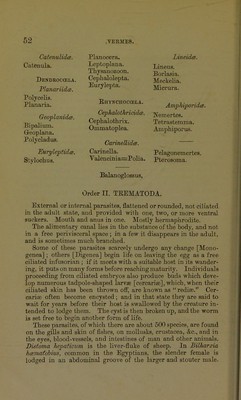
![CatenulidxB. Planocera. Leptoplana. Lincidce. Catenula. Lineua. Eorlasia. Meckelia. Micrura. Dendroccela. Planar iidce. Thysanozoon. Oephalolepta. Eurylepta. Polycelis. Planaria. Bipalium. Geoplan a. Polycladua. Gcoplanida. Cephalothricidas. jTemertes. Cephalothrix. Tetrastemma. Ommatoplea. Amphiporus. CarinellidiB. Eurylcptidce. Stylochus. Carinella. Valencinia=Polia. Pelagonemertes. Pterosoma. Balanoglossus. Order II. TEEMATODA. External or internal parasites, flattened or rounded, not ciliated in the adult state, and provided with one, two, or more ventral suckers. Mouth and anus in one. Mostly hermaphrodite. The alimentary canal lies in the substance of the body, and not in a free perivisceral space ; in a few it disappears in the adult, and is sometimes much branched. Some of these parasites scarcely undergo any change [Mono- genea] ; others [Digenea] begin life on leaving the egg as a free ciliated infusorian ; if it meets with a suitable host in its wander- ing, it puts on many forms before reaching maturity. Individuals proceeding from ciliated embryos also produce buds which deve- lop numerous tadpole-shaped larvae [corcarise], which, when their ciliated skin has been thrown off, are known as “ redise.” Cer- carise often become encysted; and in that state they are said to wait for years before their host is swallowed by the creature in- tended to lodge them. The cyst is then broken up, and the worm is set free to begin another form of life. These parasites, of which there are about 500 species, are found on the gills and skin of fishes, on mollusks, Crustacea, &c., and in the eyes, blood-vessels, and intestines of man and other animals. Distoma hepaticum is the liver-fluke of sheep. In Bilharzia hcematobius, common in the Egyptians, the slender female is lodged in au abdominal groove of the larger and stouter male.](https://iiif.wellcomecollection.org/image/b28090688_0066.jp2/full/800%2C/0/default.jpg)