Contributions to the analysis of the sensations / by Dr. Ernst Mach ... Tr. by C. M. Williams. With thirty-seven cuts.
- Ernst Mach
- Date:
- 1897
Licence: Public Domain Mark
Credit: Contributions to the analysis of the sensations / by Dr. Ernst Mach ... Tr. by C. M. Williams. With thirty-seven cuts. Source: Wellcome Collection.
Provider: This material has been provided by the Augustus C. Long Health Sciences Library at Columbia University and Columbia University Libraries/Information Services, through the Medical Heritage Library. The original may be consulted at the the Augustus C. Long Health Sciences Library at Columbia University and Columbia University.
224/236
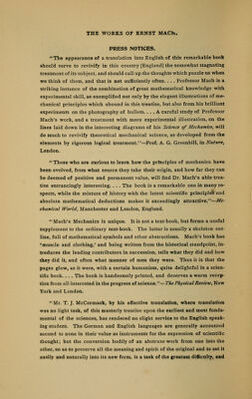
![PRESS NOTICES. The appearance of a translation into English of this remarkable book should serve to revivify in this country [England] the somewhat stagnating treatment of its subject, and should call up the thoughts which puzzle us when we think of them, and that is not sufficiently often. . . . Professor Mach is a striking instance of the combination of great mathematical knowledge with experimental skill, as exemplified not only by the elegant illustrations of me- chanical principles which abound in this treatise, but also from his brilliant experiments on the photography of bullets. ... A careful study of Professor Mach's work, and a treatment with more experimental illustration, on the lines laid down in the interesting diagrams of his Science of Mechanics, will do much to revivify theoretical mechanical science, as developed from the elements by rigorous logical treatment.—Prof. A. G. Greenhill, in Nature, London. Those who are curious to learn how the principles of mechanics have been evolved, from what source they take their origin, and how far they can be deemed of positive and permanent value, will find Dr. Mach's able trea- tise entrancingly interesting. . . . The book is a remarkable one in many re- spects, while the mixture of history with the latest scientific principles and absolute mathematical deductions makes it exceedingly attractive.—Me- chanical World, Manchester and London, England. Mach's Mechanics is unique. It is not a text-book, but forms a useful supplement to the ordinary text-book. The latter is usually a skeleton out- line, full of mathematical symbols and other abstractions. Mach's book has •muscle and clothing,' and being written from the historical standpoint, in- troduces the leading contributors in succession, tells what they did and how they did it, and often what manner of men they were. Thus it is that the pages glow, as it were, with a certain humanism, quite delightful in a scien- tific book. . . . The book is handsomely printed, and deserves a warm recep- tion from all interested in the progress of science.'—The Physical Review, New York and London. •' Mr. T. J. McCormack, by his effective translation, where translation was no light task, of this masterly treatise upon the earliest and most funda- mental of the sciences, has rendered no slight service to the English speak- ing student. The German and English languages are generally accounted second to none in their value as instruments for the expression of scientific thought; but the conversion bodily of an abstruse work from one into the other, so as to preserve all the meaning and spirit of the original and to set it easily and naturally into its new form, is a task of the greatest difficulty, and](https://iiif.wellcomecollection.org/image/b21213963_0224.jp2/full/800%2C/0/default.jpg)
 No text description is available for this image
 No text description is available for this image
 No text description is available for this image