Licence: Attribution-NonCommercial-NoDerivatives 4.0 International (CC BY-NC-ND 4.0)
Credit: Counseling in medical genetics / Sheldon Reed. Source: Wellcome Collection.
76/264 page 62
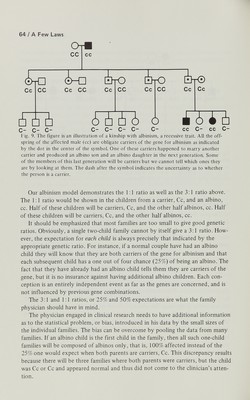
![62 / A Few Laws advantageous under some conditions and disadvantageous in other situations, thus maintaining rather high frequencies over the generations. These polymorphisms are normal traits rather than medical conditions in many cases. Autosomal Dominant Inheritance If the statistics are collected for all the children of a group of patients with Huntington's disease (chorea), it will be found that about half of these children will also develop the disease when they reach the age for its appearance. No further cases will appear in the descendants of the normal children, but if the affected persons produce children about half of them will be stricken with the disease eventually. In each succeeding generation normal individuals will always produce normal offspring, but one-half of the offspring of the affected individuals will develop the disease. If each of our patients with Huntington's disease had 2 children on the average, one who became affected and one who did not, there would be only one patient with the disease to 32,767 without the gene for it after 15 generations. This assumes that there is no reproductive advantage or disadvan¬ tage due to the presence of the Huntington's disease gene, a difficult assumption to prove. However, we do know that the choreic passes the gene down through the generations in many cases. The affected descendants get the chorea gene from the affected parent and a normal gene from the other parent. Because the chorea gene dominates the normal gene and causes the disease to appear, it is called a dominant gene or trait. The normal gene partner which is suppressed or concealed by the chorea gene is appropriately named di recessive gene. It is hard to think of normal gen^s being in the recessive state and a dominant gene being the case of a disorder. Our mind set is that almost all of our genes are dominant genes for good health, and that genes for disorders are carried by a few persons — and when two of them carry the same gene they have a chance of pro¬ ducing an affected child. This is often the case but the list of traits in which the disorder behaves as an autosomal (not on the X-chromosome) dominant is very long. McKusick [1978] lists 1,489 autosomal dominant traits. In all of these cases, the gene for normal development and good health is recessive to the dominant gene for the anomaly. He also lists 1,117 autosomal recessive traits and 205 X- hnked traits. All three mechanisms total 2,811 traits. It should be remembered that because the gene for an anomaly or disorder is at a disadvantage in most environments, it will be at a low frequency in the whole population. Consequently, few people will possess the deleterious dominant gene on both members of the relevant chromosome pair. Almost always the affected person will carry the normal recessive allele or gene partner as well as the domi¬ nant gene which is responsible for the patient's anomaly. Thus only half of the children of an affected person are affected likewise. Figure 8 illustrates the trans¬ mission from generation to generation of a gene responsible for an autosomal dominant trait.](https://iiif.wellcomecollection.org/image/b18037161_0076.JP2/full/800%2C/0/default.jpg)


 No text description is available for this image
 No text description is available for this image
 No text description is available for this image