Report of the Medical Officer of Health for the Colony on the public health ... / Cape of Good Hope.
- Cape of Good Hope (South Africa). Department of Public Health.
- Date:
- [1905]
Licence: Public Domain Mark
Credit: Report of the Medical Officer of Health for the Colony on the public health ... / Cape of Good Hope. Source: Wellcome Collection.
22/516 page 16
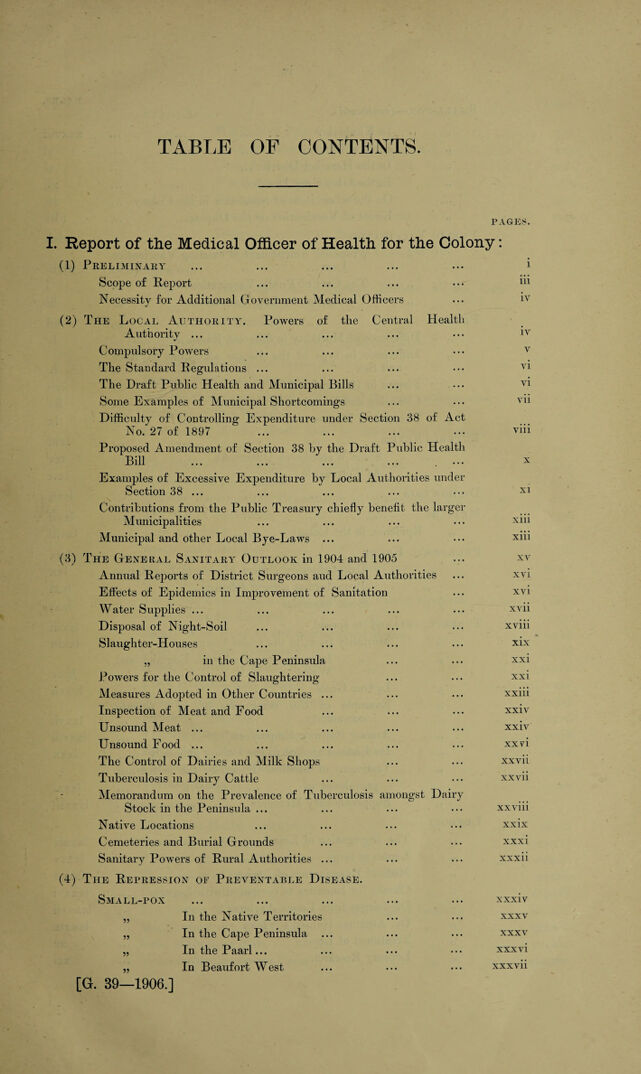
![XV] Yet the number of Local Authorities who employ such an official, even in a merely consulting capacity, remains extremely small, being in 1905, only 43, while only three Authorities in the whole Colony employ a wholetime Medical Officer, namely, the Municipality of Cape Town, the Board of Health of Kimberley, and the Municipality of Port Elizabeth, and even in the latter case, I understand that, owing to the necessity for retrenchment, the abolition of this Officer, at the conclusion of his present term of appointment, has been under consideration. Even when we come to the minor but still most important offi¬ cial, the Sanitary Inspector, a large number of Urban Local Autho¬ rities throughout the Colony do not employ any such Officer, and in many cases where a Sanitary Inspector is appointed he is burdened with other duties, which prevent him giving proper atten¬ tion to health matters. Moreover, in many of those cases where Sanitary Inspectors have been appointed the incumbent has but little knowledge or experience in the technical portion of his duties. Annual Reports of District Surgeons and Local Authorities. Printed with this Report will be found the usual Annual Health Reports of District Surgeons and Local Authorities, which deal with the sanitary condition of their respective Districts during the past two years. A perusal of these Reports will serve to shew what has been done in the way of improvement during that period and how much yet remains to be accomplished. The advisability of the system of printing these Reports in extenso has, on occasions, been called in question, on the ground that the expenditure involved is not warranted by the information which they contain. I think, however, this criticism is passed without a full knowledge of the circumstances of the case, for the value of these Reports lies not so much in the information which they con¬ tain—which, in itself, is not inconsiderable—but in the fact that the collection of information and the preparation of the Report annually draws the attention of Local Authorities and others to the sanitary condition of their area, and thus tends to promote efforts for im¬ provement which otherwise would not be likely to be aroused. The making of these Reports also gives the District Surgeons an oppor¬ tunity of getting into touch with Local Authorities and with local conditions, so that numbers of improvements could be instanced which have directly resulted from these Reports. While, on the one hand, it will be seen from the Reports that, in many Urban communities, the same sanitary defects continue to exist year after year, such as insufficient, impure and improperly protected water supplies, unsatisfactory arrangements for the re¬ moval and disposal of night-soil and other refuse, overcrowding, absence of proper arrangements for slaughtering and for the super¬ vision of the preparation and sale of food, insufficiency of control over the erection of dwellings and new buildings, insanitary condi¬ tion of locations, and a number of other matters, the Reports also shew that during the two years under review numerous improve¬ ments have been effected, in many cases of importance, and in all cases indicating increased sanitary activity. Effects of Epidemics in Improvement of Sanitation. Many of these improvements have been the direct outcome of the experience by the community of severe outbreaks of infectious](https://iiif.wellcomecollection.org/image/b31482016_0022.jp2/full/800%2C/0/default.jpg)