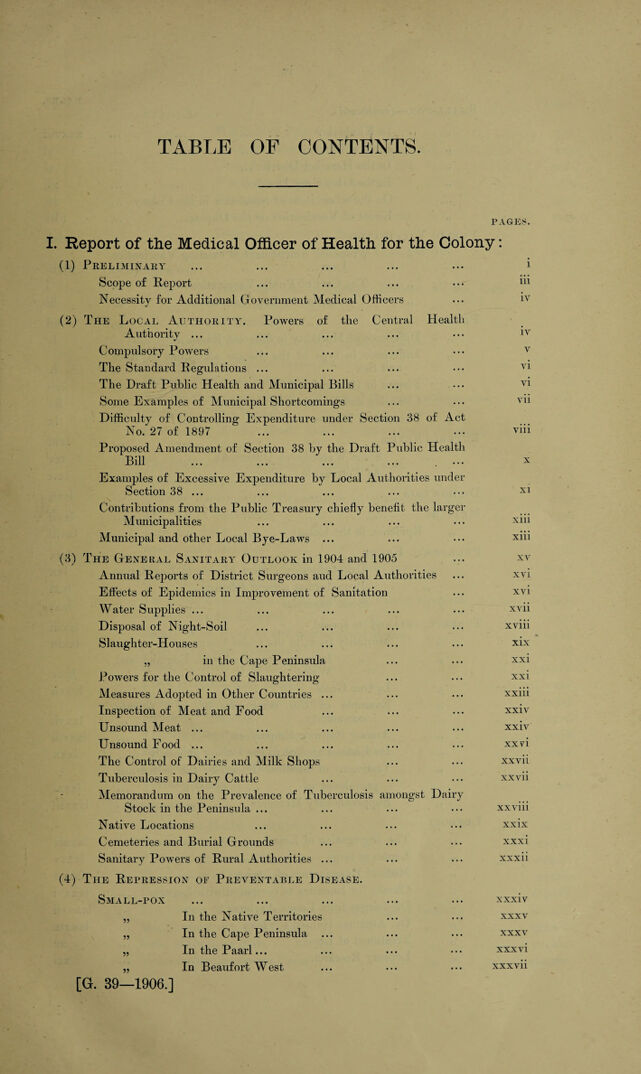
Report of the Medical Officer of Health for the Colony on the public health ... / Cape of Good Hope.
- Cape of Good Hope (South Africa). Department of Public Health.
- Date:
- [1905]
Licence: Public Domain Mark
Credit: Report of the Medical Officer of Health for the Colony on the public health ... / Cape of Good Hope. Source: Wellcome Collection.
23/516 page 17
![disease, which, in this respect, have often proved to be blessings in disguise. Thus, for example, in the Municipalities of Hanover and French Hoek, suitable schemes for the supply of their inhabitants with pure drinking water have resulted from severe outbreaks of Enteric Fever which have visited these villages in the past, accounts of which have been given in former Annual Reports. In the case of French Hoek, where the intention was to erect a Town Hall, this improvement took its place and was entirely forced upon the Municipality by the occurrence of a very severe outbreak of the disease, which threatened to permanently injure its prosperity as a scholastic centre. But, perhaps, one of the greatest factors in bringing about gen¬ eral sanitary improvement in the Colony has been the outbreaks of Bubonic Plague. This effect has been particularly noticeable in the towns where large and comprehensive cleansing schemes have been carried out by the Government, in the course of which a great number of insanitary .and unhealthy dwellings has been demolished - or re-constructed. As examples of this, we may quote the enormous improvement which occurred in Cape Town in the year 1901, consequent upon the outbreak of Plague, which not only effected the permanent exclusion of Natives from residence in the town and their settlement in locations at Maitland and in the Dock area, but led to a generally improved sanitary control over the City. Thus, much of the dangerous overcrowding, which had been taking place, chiefly in Districts 6 and 2 of the City, was done away with. In Port Elizabeth, again, a vast improvement has taken place by the same means, a great amount of slum property having been abolished or improved, and the large Native population expelled beyond its borders. Unfortunately, however, although provision was made by the Government for the housing of these displaced Natives by the establishment of the New Brighton Location, owing to the absence of adequate extra mural sanitary powers, the migrating Native and Coloured population have established insanitary communities be¬ yond the boundaries of the Municipality at Korsten and other places. At East London and King William’s Town, where Plague also occurred with some severity, and comprehensive schemes were undertaken by the Government, the same improvement has been wit¬ nessed. In all these cases the effect of the sanitary measures has been demonstrated by an almost immediate decided drop in the rate of mortality of the town. Thus, in Port Elizabeth, the drop has been, in the case of the European population, from 18-98 per thousand in i902 to 12-96 in 1905, and of the Coloured, from 98-24 to 32-96 per thousand. In East London, the rate has fallen from 1902 to 1905, among Europeans, from 15-54 to 13-27, and among Coloured, from 25-82 to 17-83 per thousand. Water Supplies. The two most common and, at the same time, most important, needs of Urban areas in this Colony, are pure and adequate water supplies and proper means for the disposal of night-soil. With regard to the former of these, each year sees some improve¬ ment effected in the water supplies of some of the towns, and although improvement does not take place as quickly as could be desired, there is the satisfaction of knowing that such improvement as is made is usually of a permanent character. During the period under review, the Municipality of East Lon- [G. 39—1906.] c](https://iiif.wellcomecollection.org/image/b31482016_0023.jp2/full/800%2C/0/default.jpg)