Report of the Medical Officer of Health for the Colony on the public health ... / Cape of Good Hope.
- Cape of Good Hope (South Africa). Department of Public Health.
- Date:
- [1905]
Licence: Public Domain Mark
Credit: Report of the Medical Officer of Health for the Colony on the public health ... / Cape of Good Hope. Source: Wellcome Collection.
39/516 page 33
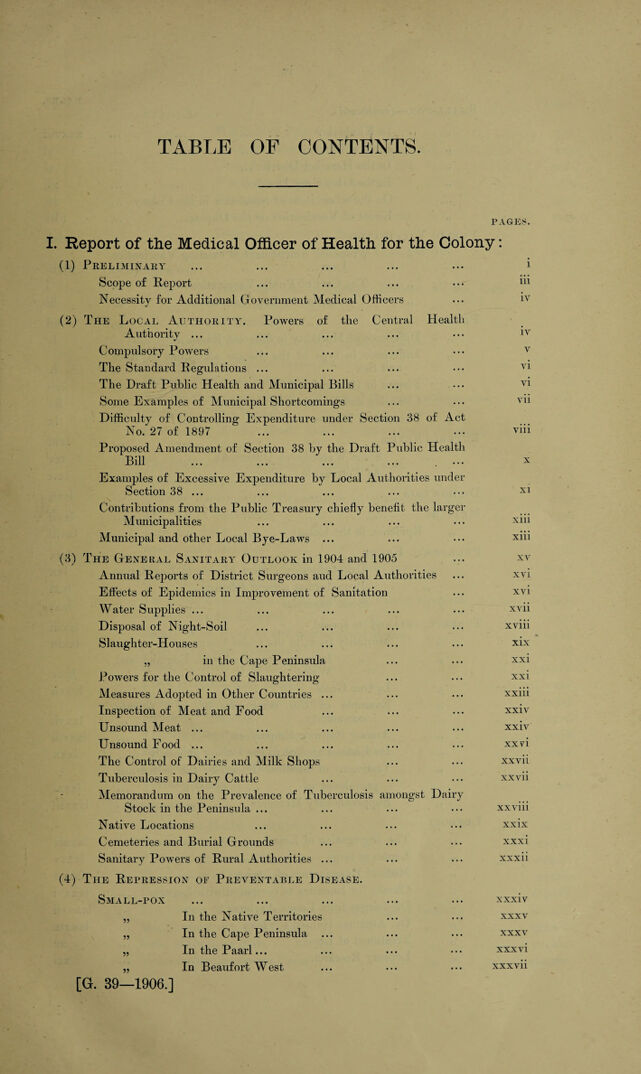
![gards absence of roads and means of access for sanitary purposes as to render the areas impossible of future sanitary administration without the outlay of considerable sums of public money in the making of improvements. Such communities are entirely without proper water supplies and adopt no means whatever of dealing with the removal and disposal of night-soil and refuse. They have thus been the occasion of serious outbreaks of disease which, as in the case of Small-pox, has not been confined to the members of the communities themselves, but has by them been spread to surround¬ ing Districts. Naturally, Municipalities upon whose borders this state of things has arisen by no fault of their own, are averse to extending their boundaries so as to include these areas and thus bring them under proper Municipal Administration, for to do so would entail, as I have said, a considerable outlay, the bulk of which would fall upon the ordinary revenue of the Municipality, owing to the fact that, in most cases, the rateable value of such areas is very small and conse¬ quently the rates to be levied therefrom practically inconsiderable. On the other hand, but little good can be expected by the establish¬ ment over any such area of an independent Local Authority in the shape of a Village Board, or other Body, inasmuch as suitable per¬ sons to serve on such a Local Authority are rarely obtainable, and moreover, the revenue which could be raised by it would be quite insufficient to enable it to undertake a proper sanitary administra¬ tion. The point, however, which I wish to emphasize in regard to such areas is that they want sanitary control at the beginning, in the early stages of their growth, so that the evolution of conditions which will hamper the future sanitation and well-being of the com¬ munity may be prevented; but, such control, to be effective, must be exercised at a time long before the community is of sufficient growth to renderAmy separate autonomy possible ; and it therefore follows that such control can only be obtained through the Rural Authority within whose limits the area lies. There is, also, another consideration that the establishment of numerous small and incapable Local Authorities is to be discouraged, as such Bodies are comparatively costly and are more frequently a drag upon im¬ provement than otherwise. Years ago, in the original Public Health Amendment Bill laid be¬ fore Parliament, such powers for Rural Authorities were provided, but, unfortunately, mainly owing to the opposition of Rural interests, they were cut out of the Bill by Parliament. Provision has, how¬ ever, been again made for them in the recentlv published Public Health Bill, to which in this Report I have so frequently alluded. The proposed “ Rural Councils Bill ” also deals with the same sub¬ ject. In the meantime, considerable assistance has been rendered to Divisional Councils by the recent judgment of the Supreme Court, in the case of Rex versus Findlay, delivered on the 21st- August, 1905, which laid down that Divisional Councils are Local Authorities for the purposes of Sections 50 and 51 of “ The Public Health Amend¬ ment Act, 18*97,” the words “ Local Authority ” in these Sections hav¬ ing hitherto been interpreted to mean only Urban Local Authorities. By this ruling a Divisional Council is enabled to issue orders and to applv to the Court in respect of “ nuisances ” arising within its District, including the pollution of drinking water, the use of houses unfit for human habitation, and the overcrowding of dwellings and the slaughtering of cattle. It is with diffidence that I must, person¬ ally, confess to some doubt as to the soundness of this ruling, but [G. 39—1906.] d h](https://iiif.wellcomecollection.org/image/b31482016_0039.jp2/full/800%2C/0/default.jpg)