Licence: Public Domain Mark
Credit: Principles of sanitation applicable to the construction of new vessels. Source: Wellcome Collection.
16/122 page 2
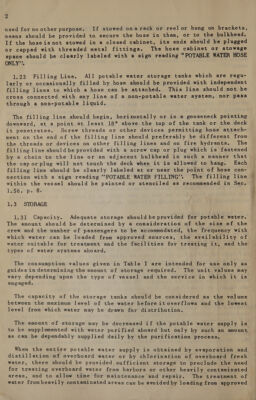
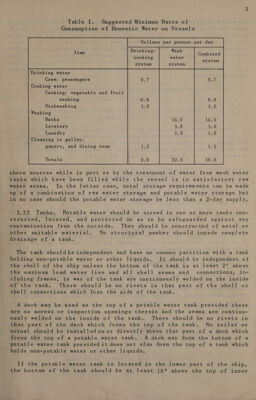
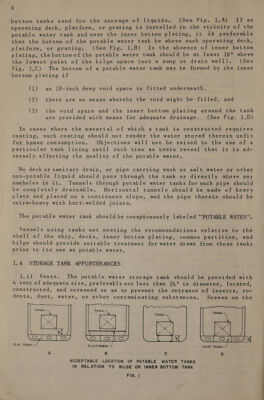
![used for no other purpose. If stowed onarack or reel or hung on brackets, means should be provided to secure the hose in them, or to the bulkhead. If the hoseisnot stowed in a closed cabinet, its ends should be plugged or capped with threaded metal fittings. The hose cabinet or stowage space should be clearly labeled with a sign reading “POTABLE WATER HOSE ONLY’’. 1.23 Filling Line. Al] potable water storage tanks which are regu- larly or occasionally filled by hose should be provided with independent filling lines to which a hose can be attached. This line should not be cross connected with any line of a non-potable water system, nor pass through a non-potable liquid. The filling line should begin, horizontally or in a gooseneck pointing downward, at a point at least 18 above the top of the tank or the deck it penetrates. Screw threads or other devices permitting hose attach- ment on the end of the filling line should preferably be different from the threads or devices on other filling lines and on fire hydrants. The filling line should be provided with a screw cap or plug which is fastened by a chain to the line or an adjacent bulkhead in such a manner that the cap or plug will not touch the deck when it is allowed to hang. Each filling line should be clearly labeled at or near the point of hose con- within the vessel should be painted or stenciled as recommended in Sec. 1.56, p. 8. 1.3 STORAGE 1.31 Capacity. Adequate storage should be provided for potable water. The amount should be determined by a consideration of the size of the crew and the number of passengers to be accommodated, the frequency with which water can be loaded from approved sources, the availability of water suitable for treatment and the facilities for treating it, and the types of water systems aboard. The consumption values given in Table I are intended for use only as guides in determining the amount of storage required. The unit values may vary depending upon the type of vessel and the service in which it is engaged. The capacity of the storage tanks should be considered as the volume between the maximum level of the water before it overflows and the lowest level from which water may be drawn for distribution. The amount of storage may be decreased if the potable water supply is to be supplemented with water purified aboard but only by such an amount as can be dependably supplied daily by the purification process. When the entire potable water supply is obtained by evaporation and distillation of overboard water or by chlorination of overboard fresh water, there should be provided, sufficient storage to preclude the need for treating overboard water from harbors or other heavily contaminated areas, and to allow time for maintenance and repair. The treatment of water fromheavily contaminated areas can be avoided by loading from approved RT ica Sica](https://iiif.wellcomecollection.org/image/b32176077_0016.jp2/full/800%2C/0/default.jpg)

 No text description is available for this image
 No text description is available for this image
 No text description is available for this image