Licence: Public Domain Mark
Credit: Principles of sanitation applicable to the construction of new vessels. Source: Wellcome Collection.
21/122 page 7
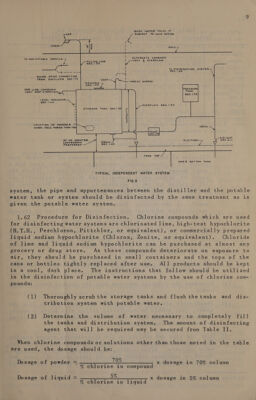
![should be no blind or spectacle flanges, or removable or swing sections of pipe in the line whereby such a connection can be made. The suction line should be located as high as practicable, preferably above a working deck or platform, with the purpose in view of preventing submergence in bilge water. It should not pass through tanks provided for non-potable liquids. 1.52 Pumps. The potable water pump should have adequate capacity for service demands and should be used for no purpose other than pumping potable water. The installation of a stand-by pump is recommended to take care of emergencies or a break down in the main unit serving the potable water system. Hand pumps, which are installed on some vessels to serve galleys, pan- tries, and the like, for emergency or routine use as a supplement to pressure outlets, should be constructed and installed so as to prevent the entrance of contamination into the potable water storage tank or in- to the water being pumped. In the case of the bar-handle type of lift pump, (1) the pump head should be the enclosed type with a stuffing box around the pump rod and should have a downward-directed, en- closed spout, (2) the pump base should be designed to support the pump and the drop pipe should be a solid, one-piece, recessed type, cast integrally with or threaded to the pump column or stand, and (3) the water cylinder should be so constructed and installed that hand priming will not be necessary. Pump heads with slotted tops and pitcher-type pumps should not be in- stalled. 1.53 Pneumatic (Pressure) Tank. If compressed air is to be intro- duced into a pneumatic tank, it should be supplied by a “snifter’’ (air intake) air valve on the potable water pump, an independent compressor, through a “press-on’’ valve witha filter or liquid trap installed in the supply line from the main compressed-air system, or an equivalent device to prevent contamination of the potable water. 1.54 Distribution System. The potable water distribution system should be independent of all] other water systems. Locked valves, blind or spectacle flanges, or removable sections of pipe should not be used as a means of separating a potable water system from one conveying water of lower quality. . The distribution system should be protected against the introduction of contamination by backflow as specified in Sec. 6.22, p. 26. A direct or continuous connection from the potable water system should not be made to operate an aspirator or ejector or other hydraulically- operated devices, or for the cooling of machinery. A hot water heating,](https://iiif.wellcomecollection.org/image/b32176077_0021.jp2/full/800%2C/0/default.jpg)
 No text description is available for this image
 No text description is available for this image
 No text description is available for this image