Licence: Public Domain Mark
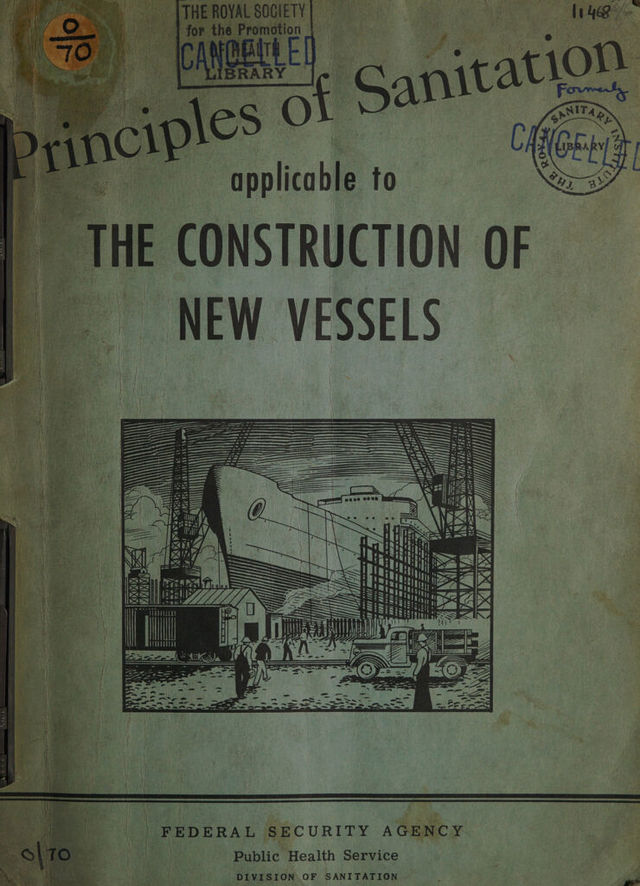
Credit: Principles of sanitation applicable to the construction of new vessels. Source: Wellcome Collection.
49/122 page 35
![10. GENERAL SANITATION 10.1 CONSTRUCTION IN FOOD AND LIVING SPACES Surfaces, including flooring, within food and living spaces should be constructed so asto facilitate cleaning. Molding or molded coves should be installed incorners wherever practicable, particularly inthose formed by bulkheads and decks, or by sheathing and floor covering. _ Living quarters should be constructed so as to prevent places of har- borage for vermin. It is preferable that they be formed of single bulk- heads and deckheads. Perforated, sound-proofing sheathing over voids or insulation should not beinstalled in food preparation or storage spaces. (See Sec. 22.222, p- 91) Its use in quarters and passageways creates harborage for smal] vermin and may result in serious vermin infestation. If installed, the material should be adequately treated before installation, and with suf- ficient frequency thereafter, to control infestation. Its use in other spaces is not particularly hazardous. 3 Lockers should be constructed where practicable as an integral part of a bulkhead, deck, or deckhead of.a compartment. When lockers are de- signed as separate fixtures, they should be of smooth metal, elevated above the deck, and have a sloping top upon which trash and waste cannot accumulate and which can be readily inspected. The corner angles should not be extended above the top. Beds and bunks should preferably be of open-type construction. They should be constructed and installed so as to minimize harborage for rats and other vermin. When tubular material is used in the construction of either the bed or the spring frame, such tubes should be blocked with .cement or metal at suitable places in order to prevent the entrance of vermin. All holes in the tube should be sealed. Drain holes in the top and bottom edges of hollow metal doors need not be ratproofed. oda. 10.2 WASTE STORAGE AND DISPOSAL Adequate provisions should be made for the storage and disposal of waste. Cans with tight-fitting covers should be provided for the col- lection of garbage in galleys, pantries, sculleries, and other spaces where food and utensils are cleaned. Unless provisions are made for the incineration of garbage on the vessel, special facilities for itsstorage while in port should be provided if: (1) The disposal of garbage from the ship to land or overboard is prohibited by local ordinances or plant quarantine law. (2) Collection service at the pier is not available. Garbage grinders should not beconnected to potable or wash water lines unless an air gap is installed in the supply line; if water from the](https://iiif.wellcomecollection.org/image/b32176077_0049.jp2/full/800%2C/0/default.jpg)
 No text description is available for this image
 No text description is available for this image
 No text description is available for this image