The prevention and treatment of blowfly strike in sheep : report no. 2 / by the Joint Blowfly Committee (Appointed by the Council for Scientific and Industrial Research and the New South Wales Department of Agriculture).
- Date:
- 1940
Licence: In copyright
Credit: The prevention and treatment of blowfly strike in sheep : report no. 2 / by the Joint Blowfly Committee (Appointed by the Council for Scientific and Industrial Research and the New South Wales Department of Agriculture). Source: Wellcome Collection.
13/52 page 11
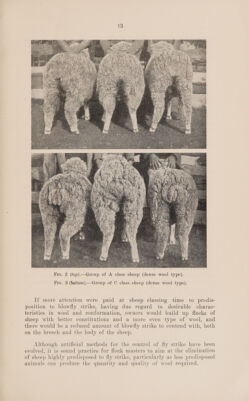
![1] certain amount of “ development ” (skin folds and wrinkling) in order to maintain density and bulk of fleece, and that plain-bodied, plain- breeched sheep carry light open fleeces. As opposed to these opinions, the following facts are quoted :— (1) Plain breeched Merino ewes retained in studs carry dense soft wool of high character. (11) Some of the best Merino rams seen on stud properties and at Sydney Sheep Shows are perfectly plain behind and would be classified as A. (111) Breeders themselves have realized that density is not neces- sarily dependent upon wrinkliness, since during the past 25 years, there has been a great change in the conformation of Merino sheep, and even those breeders who believe in the need for “ development ” do not favour the excessively wrinkled animals that took prizes some years ago. (iv) In making alterations in their standards of what constitutes a good sheep, breeders have not had the blowfly problem especially in mind, but they have evolved a larger framed sheep of good constitution, comparatively plain in the body, and carrying long stapled wool of good density. (v) Low predisposition to blowfly attack need not be accompanied by lack of quality in the wool. The relatively plain- breeched sheep at Nyngan Experiment Station have fur- nished a larger percentage of top line wool than the more wrinkly-breeched sheep. (See Figs. 2 and 3.) (vi) Although the A class sheep may produce a lower weight of greasy fleece, the yield is higher, so that less difference is apparent in the weight of clean scoured wool produced*. (vil) Examination of a considerable number of ewes culled at the annual sheep classing on both stud and flock properties has revealed that a very high percentage of the ewes culled are of the C class. These sheep were culled not on account of their breech wrinkles, but because the ewes were undesirable for other reasons, chiefly unevenness of the wool. The following two examples are given :— (a) A line of sheep in which practically no attention was paid to the breech region during classing revealed the following figures :— e A Retained Flock U neulled Flock. (Breeding Ewes). Culls. Class. i Number. Pee Number. Per cent. Number. | Per cent. eo ie Meo MT ss Cee LE —! ae aes owt | | A. ee See om 86 46 ae oc) pat BW... | 104 | 44 59 32 | 45 | on C: | 101 60 41 De Oe a) ee](https://iiif.wellcomecollection.org/image/b32175851_0013.jp2/full/800%2C/0/default.jpg)