The prevention and treatment of blowfly strike in sheep : report no. 2 / by the Joint Blowfly Committee (Appointed by the Council for Scientific and Industrial Research and the New South Wales Department of Agriculture).
- Date:
- 1940
Licence: In copyright
Credit: The prevention and treatment of blowfly strike in sheep : report no. 2 / by the Joint Blowfly Committee (Appointed by the Council for Scientific and Industrial Research and the New South Wales Department of Agriculture). Source: Wellcome Collection.
21/52 (page 19)
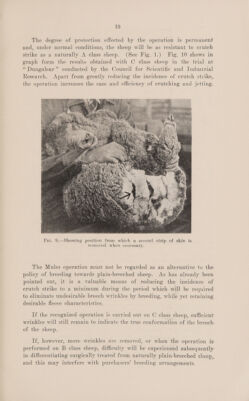
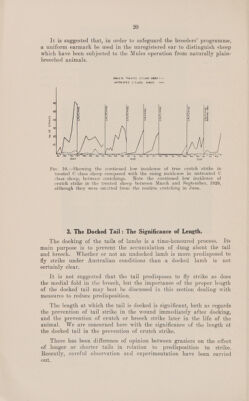
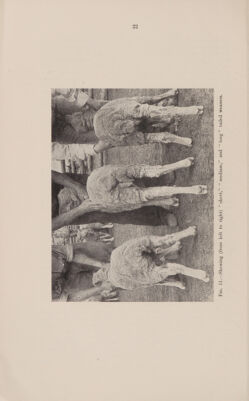
![L The degree of protection effected by the operation is permanent and, under normal conditions, the sheep will be as resistant to crutch strike as a naturally A class sheep. (See Fig. 1.) Fig. 10 shows in graph form the results obtained with C class sheep in the tria] at “ Dungalear ” conducted by the Council for Scientific and Industrial Research. Apart from greatly reducing the incidence of crutch stvike, the operation increases the ease and efficiency of crutching and jetting. The Mules operation must not be regarded as an alternative to the policy of breeding towards plain-breeched sheep. As has already been pointed out, it is a valuable means of reducing the incidence of crutch strike to a minimum during the period which will be required to eliminate undesirable breech wrinkles by breeding, while yet retaining. desirable fleece characteristics. If the recognized operation is carried out on C class sheep, sufficient wrinkles will still remain to indicate the true conformation of the breech: of the sheep. If, however, more wrinkles are removed, or when the operation is: performed on B class sheep, difhiculty will be experienced subsequently: in differentiating surgically treated from naturally plain-breeched sheep, and this may interfere with purchasers’ breeding arrangements.](https://iiif.wellcomecollection.org/image/b32175851_0021.jp2/full/800%2C/0/default.jpg)