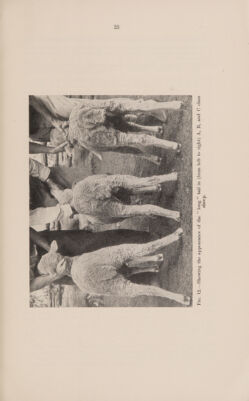
The prevention and treatment of blowfly strike in sheep : report no. 2 / by the Joint Blowfly Committee (Appointed by the Council for Scientific and Industrial Research and the New South Wales Department of Agriculture).
- Date:
- 1940
Licence: In copyright
Credit: The prevention and treatment of blowfly strike in sheep : report no. 2 / by the Joint Blowfly Committee (Appointed by the Council for Scientific and Industrial Research and the New South Wales Department of Agriculture). Source: Wellcome Collection.
27/52 page 25
![Ill. MEASURES TO REDUCE IMMEDIATE SUSCEPTIBILITY. After adequate measures have been taken to establish a flock in which inherent predisposition to fly strike has been reduced to a minimum, attention will have to be given to those measures which may become necessary to control actual susceptibility to strike that will develop under certain conditions. It is unsound practice to depend entirely on the measures to be described in this section for the control of fly strike in a flock. In nearly all cases, they are to be regarded as supplementary to the measures outlined in the preceding section. 1. Shearing : Crutching (and Ringing). (a) Shearing. By common consent, shearing is probably the most efficient method yet known of reducing susceptibility to fly strike, and it forms an integral part of any programme for its contro] or prevention. Shearing just prior to, or at the beginning of, what is normally the worst fly season of the year will usually give a good deal of protection, and may even completely tide over that particular fly wave. If fly strike commences earlier than expected, and shearing is in progress during a wave, there may occasionally be serious trouble from strike in shear cuts, but this is exceptional and may be guarded against by the use of boric acid dressings on the more serious cuts, Sheep with plain breeches or those that have been previously subjected to the Mules operation are less likely to be injured on the breech. In some districts, it is advisable to shear at a certain time in order to evade the effects of a heavy crop of grass seed. Under these circumstances, it may be necessary to shear at some time other than the optimal for the control of fly strike. As the time of the worst fly wave varies from district to district, it is impossible to make any general recommendation as to dates. It must be left to the flock master, bearing in mind the efficiency of shearing as a preventive measure, to weigh carefully such factors as availability of shearers, lambing dates, and grass seeds, in selecting the time which = meet each poigine ion of circumstances to the best advantage. (6) Crutching. Crutching is the measure most commonly adopted for the prevention of strike in the region of the breech. It consists of shearing the wool away from the breech, over the tail, and down the back of the hind legs. The object of crutching in blowfly strike contro] is to make the area unattractive to the fly by keeping it clean and dry. One crutching at or near mid-season has value, in addition to the protection it confers, by preventing the occurrence of excessively dirty wool at shearing. The value of crutching in the prevention of fly strike of the breech area is undoubted. Jt 7s a most efficient method of reducing susceptibility of sheep to crutch strike, and, as its value is so well known, it is unnecessary further to stress its importance.](https://iiif.wellcomecollection.org/image/b32175851_0027.jp2/full/800%2C/0/default.jpg)