A manual of surgery for students and practitioners / by William Rose and Albert Carless.
- William Rose
- Date:
- 1899
Licence: Public Domain Mark
Credit: A manual of surgery for students and practitioners / by William Rose and Albert Carless. Source: Wellcome Collection.
30/1194 (page 30)
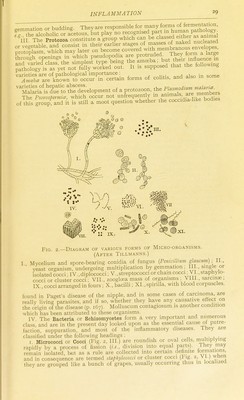
![A MANUAL OF SURGERY when they occur in pairs , * 8 mflammations; dipiococci (Fie 2 IV \ gonorrhoea and ^^'^ti^^^^»- pef 4^ of four or eight individuals, they Ire usuallterZ* fre ^rouP«d into packets Occasionally any of the ahnvP L usually termed sarcince Fig. 2 VIII ) break up into the so-called commashaped bar?! T™1 ^ which m^ body of their host as isolated rods Sn the hU°r Ty Persist in th« They multiply by fission, or by the formJtio*of 06 °f *6 Cells invaded' These latter are much more resistnT,n^T -,°f ,Spores ln their interior rods. The spore may™^^^^^^^ tha» the parent authracis, or at one end, as in the so caLd T I h\bacillus, as in the B. 3- Spirilla (Fig. 2 XI ) form rorL^ Arui?stlck-shaped B. tetani CFie 16) of movement! ^i^l^S^^f' Passing active power pathology only occu^i? a few LSSg %j^£SS£%4? » hUm*n actt^oftS v^eL^Lifmf h6re ^ t0 the We hist-y -d mode of ^^^^^n^^^^, ^ributio, Earth, air, greater the number of the inhabiLn s the |a P°Pl!lous neighbourhoods. The the air. On the high Alps anI n isolated efo'ecSn °f °rganisms in there are comparatively few whilst m f^ !f f Y mountamous, districts, swarms of them are preW and1 these off* of °f * ^°wded hosPital ward surface of our bodies and theintestinal ran/l * most dangerous type. The although in a healthy individua the snKd o ' ^f' teem wi'h them, practically free. Any condi ion ogeneral w^5' b, °°d and ^P*1' ^ into the system, or perhaps one shonW ^ weakness facilitates their entrance body to their presence and^vity and n^', T^u63-the resistance of the occurrence of diverse infectivedieases yS the lndividual open to the t^a'^ movements. Most bacilli and sdrilff,! ?°nfe?« particles, • Brownian • from place to place, accomSffil^,1^^0'he P°w of moving one or both ends as singfoP filaments o ?n\ °l ^ deVe'°P either a< demonstrated in the Bac tyPJw»™ hunches. These can be readily TwMot£n^^ endospores. Spore formation e oCCUr in ^ {ormati™ °' although common amongst the bacilli i^ nnMn - uf °°?C1 or sarcin££, and and Bac. diphtheria are afporojenou ' Onfv nZ ^ i thuS the Bae- Wh°™ and, as already stated, itsposftion varied fn££ PT {°TmS in each ^llus. favourable to the developmerto^ spores W nn? Tu^ < The editions but in most varieties a free supply of oxveenis rt? J™ ascertained, spores never form amongst the^ing S^oftbX? * ^ * faCt that Results of Growth.-The activity and development nf n_ t • logical phenomena, carried out in accordance S th bacteria are physio- animal and vegetable life, and requhtg^^IS^1^-8°VeiaiDS present. The pabulum or food-stuff rtlLZ definite conditions to be species, but they all require wfter ox^^nT6^ with the Particular certain inorganYc salts T^^^^^^^' carb°», and substances than on more simple materials As to hP; g y comP]lcated logical conditions, one divides^hem nto two great daSSe-TcaT*] * ^u0' or not they can develop in the living dsiue, ^C^rt • g t0 whether bacteria can do so, producing what are^Tas- inTectiv?fees; £?S£](https://iiif.wellcomecollection.org/image/b20397318_0030.jp2/full/800%2C/0/default.jpg)