On the causes of mortality after amputation of the limbs. Pt. II. Diseases / by J.H. James.
- John James
- Date:
- 1850
Licence: Public Domain Mark
Credit: On the causes of mortality after amputation of the limbs. Pt. II. Diseases / by J.H. James. Source: Wellcome Collection.
Provider: This material has been provided by The Royal College of Surgeons of England. The original may be consulted at The Royal College of Surgeons of England.
22/46 page 20
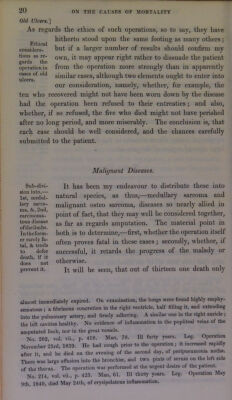
![Old Ulcern.'] As regards the ethics of such operations, so to say, they have ^ hitherto stood upon the same footing as many others; considera- but if a larger number of results should confirm my ganL the appear right rather to dissuade the patient operation in from the operation more strongly than in apparently S[cere°^ similar cases, although two elements ought to enter into our consideration, namely, whether, for example, the ten who recovered might not have been worn down by the disease had the operation been refused to their entreaties and also, whether, if so refused, the five who died might not have perished after no long period, and more miserably. The conclusion is, that each case should be well considered, and the chances carefully submitted to the patient. Sub-divi- sion into,— 1st, medul- lary sarco- ma, &,2nd, carcinoma- tous disease of the limbs. Intheform- er rarely fa- tal, & tends to defer death, if it does not prevent it. Malignant Diseases. It has been my endeavour to distribute these into natural species, as thus,—medullary sarcoma and malignant osteo sarcoma, diseases so nearly allied in point of fact, that they may well be considered together, as far as regards amputation. The material point in both is to determine,—first, whether the operation itself often proves fatal in these cases; secondly, whether, if successful, it retards the progress of the malady or otherwise. It will be seen, that out of thirteen one death only almost immediately expired. On examination, the lungs were found highly emphy- sematous ; a fibrinous concretion in the right ventricle, half filling it, and extending into the pulmonary artery, and firmly adhering. A similar one in the right auricle; the left cavities healthy. No evidence of inflammation in the popliteal veins of the amputated limb, nor in the great vessels. No. 202, vol. vii., p. 418. Man, 78. lU forty years. Leg. Operation November 23rd, 1839. He had cough prior to the operation; it increased rapidly after it, and he died on the evening of the second day, of peripneumonia notha. There was large effusion into the bronchise, and two pints of serum on the left side of the thorax. The operation was performed at the urgent desire of the patient. No. 214, vol. vii., p. 423. Man, 61. Ill thirty years. Leg. Operation May 9th, 1840, died May 24th, of erysipelatous inflammation.](https://iiif.wellcomecollection.org/image/b22368462_0024.jp2/full/800%2C/0/default.jpg)


 No text description is available for this image
 No text description is available for this image
 No text description is available for this image