On the causes of mortality after amputation of the limbs. Pt. II. Diseases / by J.H. James.
- John James
- Date:
- 1850
Licence: Public Domain Mark
Credit: On the causes of mortality after amputation of the limbs. Pt. II. Diseases / by J.H. James. Source: Wellcome Collection.
Provider: This material has been provided by The Royal College of Surgeons of England. The original may be consulted at The Royal College of Surgeons of England.
24/46 page 22
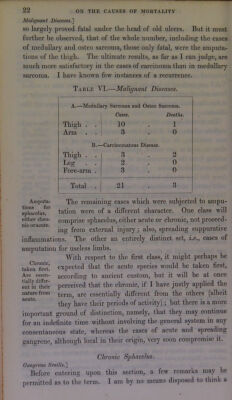
![Malignant Diseases.] SO largely proved fatal under the head of old ulcers. But it must further be observed, that of the whole number, including the cases of medullary and osteo sarcoma, those only fatal, were the amputa- tions of the thigh. The ultimate results, as far as I can judge, are much more satisfactory in the cases of carcinoma than in medullary sarcoma. I have known few^ instances of a recurrence. Table VI.—Malignant Diseases. A.—Medullary Sarcoma and Osteo Sarcoma. Thigh . . Cases. 10 Deaths. 1 Arm 3 • 0 B.- -Carcinomatous Disease. Thigh . . 3 • 2 Leg . . 2 • 0 Fore-arm . 3 • 0 Total 21 • 3 Amputa- The remaining cases which were subjected to ampu- sphacelus?*^ tation Were of a different character. One class will either chro- comprise sphacelus, either acute or chronic, not proceed- nicor c . from external injury; also, spreading suppurative inflammations. The other an entirely distinct set, i.e., cases of amputation for useless limbs. With respect to the first class, it might perhaps be takenXsL expected that the acute species wmuld be taken first. Are essen- according to ancient custom, but it will be at once eS*^their perceived that the chronic, if I have justly applied the nature from essentially difirerent from the others (albeit acute. periods of activity); but there is a more important ground of distinction, namely, that they may continue for an indefinite time without involving the general system in any consentaneous state, whereas the cases of acute and spreading gangrene, although local in their origin, very soon compromise it. Chronic Sphacelus. Gangrena Senilis.] Before entering upon this section, a few remarks may be permitted as to the term. I am by no means disposed to think a](https://iiif.wellcomecollection.org/image/b22368462_0026.jp2/full/800%2C/0/default.jpg)


 No text description is available for this image
 No text description is available for this image
 No text description is available for this image