A Practical treatise on artificial crown- and bridge-work, and porcelain dental art / by George Evans.
- George Evans
- Date:
- 1900
Licence: Public Domain Mark
Credit: A Practical treatise on artificial crown- and bridge-work, and porcelain dental art / by George Evans. Source: Wellcome Collection.
Provider: This material has been provided by the Augustus C. Long Health Sciences Library at Columbia University and Columbia University Libraries/Information Services, through the Medical Heritage Library. The original may be consulted at the the Augustus C. Long Health Sciences Library at Columbia University and Columbia University.
362/398 page 338
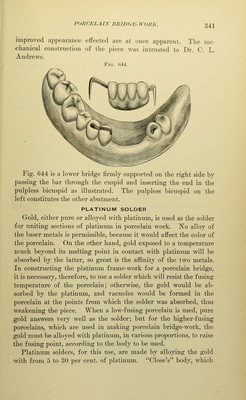
![on the model, into which the struck-up platinum saddle can be fitted. By this latter method any degree of pressure on the al- veolar ridge on the part of the saddle is obtained and any gauge of platinum desired can be used. An iridio-platinum cross-bar, made of ISTo. 14 gauge round wire flattened to jSTo.. 16 gauge and set on edge, is extended from the post of one cap to the post of the other, fitting closely against or on the posts, and resting on the caps and saddle (see Fig. 637). The saddle is next soldered to the caps, and the cross-bar to the caps and saddle, with 20 per cent, platinum solder. To retain the bar in position on the caps, a little investing material should be placed crosswise over the bar in the center of the investment; as soon as the saddle and the ends of the bar are soldered, this little piece of investment is removed and the soldering of the bar com- pleted. This frame-work makes a metallic structural foundation for the bridge, the strength and rigidity of which will not be im- paired in fusing on the porcelain body. Body such as Close's fuses at a temperature which will not melt a grade of platinum solder above 15 per cent. The piece is next adjusted in the mouth, the caps held solidly in position, and the platinum pressed and burnished against the tissues at any spots that seem to suggest it, and at the edges, sufiiciently to make a white line at the margin, but not enough to cut into the tissues. This is not done for the purpose of obtaining alveolar support, but for the exclusion of particles of food from under the bridge, a condition that is main- tained even though slight absorption of the membrane should supervene. Impression compound is next placed on the bridge and an impression of the occluding teeth taken. ]^[ext wax is placed inside each of the caps to exclude the plaster and render removal easy, and plaster articulating models are made. Facings, or suitable teeth with long pins, are selected and the under side of the pins ground flat, to present a larger surface of contact to the bar. The facing-s are ground, fitted, waxed in position, the bridge-work removed for the model, and invested in plaster and asbestos. The wax is removed, each pin is bent down in close contact mth the bar and soldered to it with the least possible quantity of pure gold; the case is then removed and boiled in acid. Pure gold is used for this soldering, as the heat required to flow platinum solder would be liable to etch the invested](https://iiif.wellcomecollection.org/image/b21223075_0362.jp2/full/800%2C/0/default.jpg)