Holden's Manual of the dissection of the human body / edited by Luther Holden ... and John Langton, ... ; illustrated with numerous wood engravings.
- Luther Holden
- Date:
- 1879
Licence: Public Domain Mark
Credit: Holden's Manual of the dissection of the human body / edited by Luther Holden ... and John Langton, ... ; illustrated with numerous wood engravings. Source: Wellcome Collection.
Provider: This material has been provided by University of Bristol Library. The original may be consulted at University of Bristol Library.
25/728 page 9
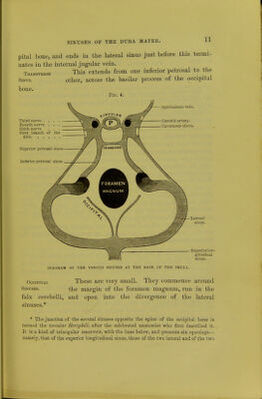
![SUPERIOE LONGITUDINAL SINUS. of blood in the sinus, and that they pass through the wall of the sinus very obliquely, like the ureter into the bladder. The probable object of this oblique entrance is to prevent regurgitation of blood from the sinus into the veins of the brain. Cut open the superior longitudinal sinus : observe that it is triangular with its base upwards, and that its cavity is intersected in many places by slender fibrous cords, termed chordce Willisii.* Their precise use is not understood. aiANDUL^ In the neighbourhood of the superior longitu- Pacchiont. dinal sinus, we meet with small white elevated granulations, sometimes arranged singly, sometimes in clusters, which are received into the depressions on the inner aspect of the skull-cap. They are termed glandulce Paccliioni,] and are found in four situations:—1. On the outside of the dura mater; often so large as to occasion depressions in the bones. 2. On the surface of the pia mater. 3. In the interior of the longitudinal sinus, covered by its lining membrane. 4. On the posterior and antero- inferior parts of the posterior lobe of the cerebrum. They are due to an increased growth of the villi, which are nor- mally found in the arachnoid membrane, and make their way, thi-ough the dura mater or the pia mater, to the different situations in which they are found. The greatest growth takes place from the visceral layer, as may be seen in the dissection of the brain. These bodies are not found at birth, but usually commence their growth about the third year, and are always found at the seventh year, after which they gradually increase as life advances. The brain should now be removed, and preserved in spirit for future examination. Its anatomy, with that of its remaining mem- branes, will be described in a subsequent part of this work. The other sinuses should now be examined. Latehal These are the two great sinuses through which Sinuses. all the blood from the brain is returned to the jugular veins. Their course is well marked in the dry skull. The * So called after Willis, who first described them in his work, 'De Cerebri Anatome,' 1664, t After the Italian anatomist who first described thom, in 1706.](https://iiif.wellcomecollection.org/image/b21443622_0025.jp2/full/800%2C/0/default.jpg)