Eleven miscellaneous papers on animal parasites / [Ch. Wardell Stiles and others].
- Date:
- 1902
Licence: In copyright
Credit: Eleven miscellaneous papers on animal parasites / [Ch. Wardell Stiles and others]. Source: Wellcome Collection.
Provider: This material has been provided by London School of Hygiene & Tropical Medicine Library & Archives Service. The original may be consulted at London School of Hygiene & Tropical Medicine Library & Archives Service.
62/82
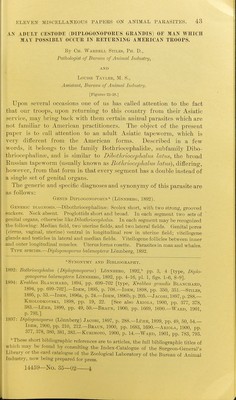
![Pig. 22.—Dorsal view of a portion of the strobila of the double-pored large tapeworm {Diplogono- porus (jranclis) of man. Natural size. After Ijima & Kurimoto, 1894, fig. 1. Tiin Double-pored Asiatic Tai-ewokm DiPi/xioNoi-oiius (iKANins- (Blanchard, 1894) LtiniJ, 1899. Specific mAoyio^iB.—Diplogonopoms: Strobila attains 10 meterfi in lenKth, 10 to 25 mm. in breadth; number of segments (?). Head undescril^ed. Neck undescrihed. Genital pores open in two longitudinal genital grooves. Gravid segmentfi contraf;ted in alcohol to 0.45 mm. long, 14 to 1(5 mm. broad. litems with but few (about two) loops each side. Eggs brownish, rather opaque, 63 f.i long, 48 to 50 /^ broad. Host.—In the intestine of man, Japan; larva unknown, in all probability in (ish. This parasite was originally described by Ijima and Kurimoto (1894) as an undetermined species of BothrwcepJialm; Blanchard (1894) created the genus Krahhea for it, proposing the specific name grandh; Luhe (1899) showed it to be congeneric with Diplogoru/porm halaenopterae^ a form reported for seals. Our entire medical knowledge of the worm we owe to Ijima and Kurimoto. Together they described, in 1894, the first- known case of infection with this parasite. A second case was described b}^ Kurimoto in 1900. The statements made by other authors are all based upon these two papers. The essential zoological facts presented in these articles, so far as they are necessary to the physician, are summarized in the diagnoses given above. As the publications in question are accessible to only a few of the phj'^sicians in this country, it may be well to quote the more important original data bearing upon the medical side of the subject. The clinical histories reported for the two known flg, 3. cases are as follows: Case I.—History: Tamaji Murazato, male, born 1865, at Taira-mura (a village on the Ariake Sea, near the town of Shimabara), in the province Hizen. In boyhood healthy, but never muscular. Kemained in his native village until 1879, when he went to Nagasaki. Here attacked by cholera, but recovered. Up to 1892 resided in several places in the neighborhood of Nagasaki and other seaside localities within Synonymy and Bibliography. 1894: Bolhriocephalus sp. I.iima & Kurimoto, 1894, pp. 371-385, pi. 18, figs. 1-12. 1894: Krabbea grandis Blanchard, 1894, pp. 699-702.—Idem, 1895, p. 728.—Idh.m, 1898, p. 350.—Stiles, 1896a, p. 25.—Idem, 1896b, p. 221.—Stiles & Hassall, 1898, pp. 85, 137.—Huber, 1896, pp. 561-562.—Moniez, 1896, pp. 255, 274- 276.—Simon, 1897, pp. 209, 222.—Idem, 1900, pp. 217, 229.—Kholodkovski, 1898, p. 22, pi. 10, figs. 1-4.—Kurimoto, 1899, p. 406. [See also Kurimoto, 1900, p. 14.—LtiuE, 1899, p. 50.] 1899: Diplogmoporm grandis (Blanchard, 1894) LtjriE, 1899, p. 50.—Idem, 1900, p. 211.—Ariola, 1900, pp. 385-386.—Kurimoto, 1900, pp. 1-16, ph. 1-2.—Ward, 1901, pp. 783, 793, figs. 1244-1245. Fig. 23.—Ventral view of .same. After Ijima & Kurimoto, 1S94, Fig. 24.—Transverse sec- tion of same. After Ijima & Kurimoto, 1894,](https://iiif.wellcomecollection.org/image/b21352331_0062.jp2/full/800%2C/0/default.jpg)