Narcotic plants and stimulants of the ancient Americans / by W.E. Safford.
- William Edwin Safford
- Date:
- [1917]
Licence: In copyright
Credit: Narcotic plants and stimulants of the ancient Americans / by W.E. Safford. Source: Wellcome Collection.
9/62 page 391
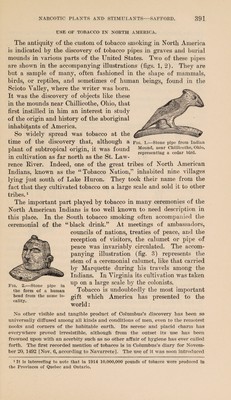
![USE OF TOBACCO IN NORTH AMERICA. The antiquity of the custom of tobacco smoking in North America is indicated by the discovery of tobacco pipes in graves and burial mounds in various parts of the United States. Two of these pipes are shown in the accompanying illustrations (figs. 1, 2). They are but a sample of many, often fashioned in the shape of mammals, birds, or reptiles, and sometimes of human beings, found in the Scioto Valley, where the writer was born. It was the discovery of objects like these in the mounds near Chillicothe, Ohio, that first instilled in him an interest in study of the origin and history of the aboriginal inhabitants of America. So widely spread was tobacco at the time of the discovery that, although a fig. I.—Stone pipe from Indian plant of subtropical origin, it was found Mound, near Chillicothe, Ohio, m cultivation as far north as the St. Law¬ rence River. Indeed, one of the great tribes of North American Indians, known as the “ Tobacco Nation,” inhabited nine villages lying just south of Lake Huron. They took their name from the fact that they cultivated tobacco on a large scale and sold it to other tribes.1 The important part played by tobacco in many ceremonies of the North American Indians is too well known to need description in this place. In the South tobacco smoking often accompanied the ceremonial of the “black drink.” At meetings of ambassadors, councils of nations, treaties of peace, and the reception of visitors, the calumet or pipe of peace was invariably circulated. The accom¬ panying illustration (fig. 3) represents the stem of a ceremonial calumet, like that carried by Marquette during his travels among the Indians. In Virginia its cultivation was taken up on a large scale by the colonists. Tobacco is undoubtedly the most important gift which America has presented to the world: Fig. 2.—Stone pipe in the form of a human head from the same lo¬ cality. No other visible and tangible product of Columbus’s discovery has been so universally diffused among all kinds and conditions of men, even to the remotest nooks and corners of the habitable earth. Its serene and placid charm has everywhere proved irresistible, although from the outset its use has been frowned upon with an acerbity such as no other affair of hygiene has ever called forth. The first recorded mention of tobacco is in Columbus’s diary for Novem¬ ber 20, 1492 [Nov. 6, according to Navarrete]. The use of it was soon introduced 1 It is interesting to note that in 1914 10,000,000 pounds of tobacco were produced in the Provinces of Quebec and Ontario.](https://iiif.wellcomecollection.org/image/b3062163x_0009.jp2/full/800%2C/0/default.jpg)