Volume 1
The annals and antiquities of Rajasthan, or The central and western Rajpoot states of India / by Lieutenant Colonel James Tod.
- James Tod
- Date:
- 1895
Licence: Public Domain Mark
Credit: The annals and antiquities of Rajasthan, or The central and western Rajpoot states of India / by Lieutenant Colonel James Tod. Source: Wellcome Collection.
80/660 page 56
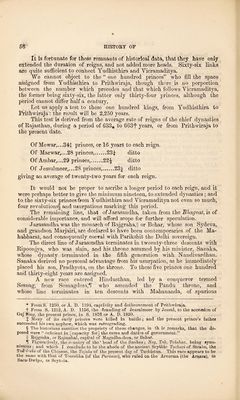
![It ia fortunate for these remnants of historical data, that they have only extended the duration of reigns, and not added more heads. Sixty-six links are quite sufficient to connect Yudhisthira and Yicramaditya. We cannot object to the “ one hundred princes” who fill the space assigned from Yudhisthira to Prithwiraja, though there is no porportion between the number which precedes and that which follows Yicramaditya, the former being sixty-six, the latter only thirty-four princes, although the period cannot differ half a century, Let us apply a test to these one hundred kings, from Yudhisthira to Prithwiraja : the result will be 2,250 years. This test is derived from the average rate of reigns of the chief dynasties of Rajasthan, during a period of 633* * * § to 663f years, or from Prithwiraja to the present date. Of Me war,... 344 princes, or 16 years to each reign. Of Marwar,...28 princes, 23i ditto Of Ambar,.,.29 prinoes, 22£ ditto Of Jessulmeer,...28 princes, 23| ditto giving an average of twenty-two years for each reign. It would not be proper to ascribe a longer period to each reign, and it were perhaps better to give the minimum nineteen, to extended dynasties ; and to the sixty-six princes from Yudhisthira and Yicramaditya not even so much, four revolutions^ and usurpations marking this period. The remaining line, that of Jarasandha, taken from the Bliagvat, is of considerable importance, and will afford scope for further speculation. Jarasandha was the monarch of Rajgraha,l| or Behar, whose son Sydeva, and grandson Marjairi, are declared to have been contemporaries of the Ma- habharat, and consequently coeval with Parikshit the Delhi sovereign. The direct line of Jarasondha terminates in tweenty-three descents with Ripoonjya, who was slain, and his throne assumed by his minister, Sanaka, whose dynasty terminated in the fifth generation with Nandivardhan. Sanaka derived no personal advantage from his usurpation, as he immediately placed his son, Pradhyota, on the throne. To these five princes one hundred and thirty-eight years are assigned. A new race entered Hindusthan, led by a conqueror termed Sesnag, from Sesnagdesa,1T who ascended the Pandu throne, and whose line terminates in ten descents with Mahananda, of spurious * FromS. 1250, or A. D. 1194, captivity and dethronement of Prithwiraja. + From S. 1212, A. D. 1156, the founding of Jessulmeer by Jessul, to the accession of Gnj Bing, the present prince, in S. 1876 or A. D. 1820. X Many of its early princes were killed in battle; and the present prince’s father succeeded his own nephew, which was retrograding. § The historians sanction the propriety of these changes, in th ir remarks, that the de- posed were “deficient in [capacity for] the cares and duties of government.” | Rajgraha, or Rajmahal, capital of Magadha-desa, or Behar. If Figuratively, the country of the ‘ head of the Snakes ; Nag, Tak, Takshac. being syno- nimous ; and which I conclude to be the abode of the ancient Scythic Tachari of Strabo, the TaJc-x-uks of the Chinese, the Tajuks of the present day of Turkistan. This race appears to be the same with that of Toorshka (of the Pxircmas), who ruled on the Arverma (the Araxes), in Saca-Dwipa, or Scytuia.](https://iiif.wellcomecollection.org/image/b29351674_0001_0080.jp2/full/800%2C/0/default.jpg)
 No text description is available for this image
 No text description is available for this image
 No text description is available for this image