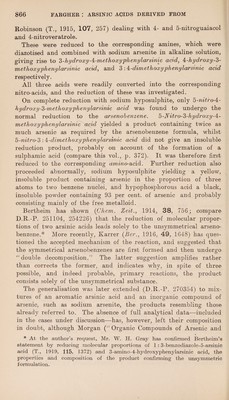
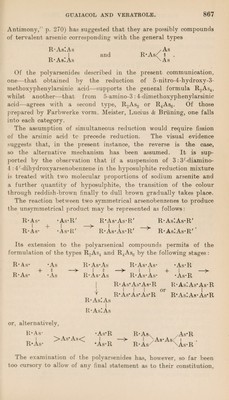
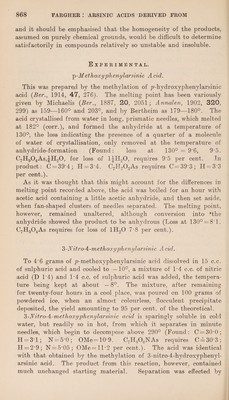
Arsinic acids derived from guaiacol and veratrole. Constitution of the polyarsenides / by Robert George Fargher.
- Fargher, Robert George.
- Date:
- 1920.]
Licence: Public Domain Mark
Credit: Arsinic acids derived from guaiacol and veratrole. Constitution of the polyarsenides / by Robert George Fargher. Source: Wellcome Collection.
5/12 page 869
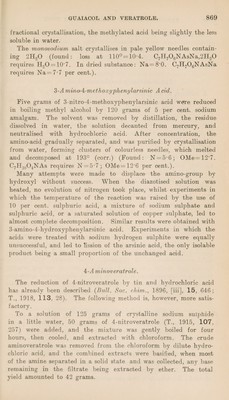
![fractional crystallisation, the methylated acid being slightly the less soluble in water. The monosodium salt crystallises in pale yellow needles contain¬ ing 2H20 (found: loss at 110°=10-4. C7H70cNAsNa,2H20 requires H2O = 10'7. In dried substance: Na=8'0. C7H706NAsNa requires Na = 7-7 per cent.). 3-4. mvnoxA-methoxyphenylarsinic A cid. Five grams of 3-nitro-4-methoxyphenylarsinic acid were reduced in boiling methyl alcohol by 120 grams of 5 per cent, sodium amalgam. The solvent was removed by distillation, the residue dissolved in water, the solution decanted from mercury, and neutralised with hydrochloric acid. After concentration, the amino-acid gradually separated, and was purified by crystallisation from water, forming clusters of colourless needles, which melted and decomposed at 193° (corr.) (Found: N = 5*6; OMe=12'7. C7H10O4NAs requires N = 5-7; OMe = 12‘6 per cent.). Many attempts were made to displace the amino-group by hydroxyl without success. When the diazotised solution was heated, no evolution of nitrogen took place, whilst experiments in which the temperature of the reaction was raised by the use of 10 per cent, sulphuric acid, a mixture of sodium sulphate and sulphuric acid, or a saturated solution of copper sulphate, led to almost complete decomposition. Similar results were obtained with 3-amino-4-hydroxyphenylarsinic acid. Experiments in which the acids were treated with sodium hydrogen sulphite were equally unsuccessful, and led to hssion of the arsinic acid, the only isolable product being a small proportion of the unchanged acid. 4-A mino-veratrole. The reduction of 4-nitroveratrole by tin and hydrochloric acid has already been described (B-ull. Soc. chim., 1896, [iii], 15, 646; T., 1918, 113, 28). The following method is, however, more satis¬ factory. To a solution of 125 grams of crystalline sodium sulphide in a little water, 50 grams of 4-nitroveratrole (T., 1915, 107, 257) were added, and the mixture was gently boiled for four hours, then cooled, and extracted with chloroform. The crude aminoveratrole was removed from the chloroform by dilute hydro¬ chloric acid, and the combined extracts were basified, when most of the amine separated in a solid state and was collected, anv base remaining in the filtrate being extracted by ether. The total yield amounted to 42 grams.](https://iiif.wellcomecollection.org/image/b30622700_0005.jp2/full/800%2C/0/default.jpg)