Literary character of men of genius : drawn from their own feelings and confessions / by Isaac Disraeli.
- Isaac D'Israeli
- Date:
- [1881?]
Licence: Public Domain Mark
Credit: Literary character of men of genius : drawn from their own feelings and confessions / by Isaac Disraeli. Source: Wellcome Collection.
42/488 page 22
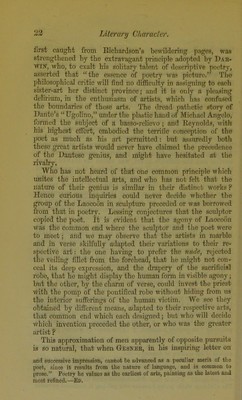
![first caught from Richardson’s bewildering pages, was strengthened by the extravagant principle adojited by Dah- wiN, who, to exalt his solitary talent of descriptive poetry, asserted that “the essence of poetry was picture.” Tlio philosophical critic will find no difficulty in assigning to each sister-art her distinct province; and it is only a pleasing delirium, in the enthusiasm of artists, which has confused the boundaries of these arts. The dread pathetic story of Dante’s “ Ugolino,” under the plastic hand of Michael Angelo, formed the subject of a basso-relievo ; and Reynolds, with his highest effort, embodied the terrific conception of the ])oet as mueh as his art permitted: but assuredly both these great artists would never have claimed the precedence of the Dantesc genius, and might have hesitated at the rivalry. Who has not heard of that one common principle which unites the intellectual arts, and who has not felt that the nature of their genius is similar in their distinct works ? Hence curious inquiries could never decide whether the group of the Laocoon in sculpture preceded or was borrowed from that in poetry. Lessing conjectures that the sculptor copied the poet. It is evident that the agony of Laocoon was the common end where the sculptor and the poet were to meet; and we may observe that the artists in marble and in verse skilfully adapted their variations to their re- spective art: the one having to prefer the nude, rejected the veiling fillet from the forehead, that he might not con- ceal its deep expression, and the drapery of the sacrificial robe, that ho might display the human form in visible agony; but the other, by the charm of verse, could invest the priest with the pomp of the pontifical robe without hiding from us the interior sufferings of the human victim. We see they obtained by different means, adapted to their respective arts, that common end which each designed; but who will decide which invention preceded the other, or who was the greater artist ? This approximation of men apparently of opposite pm'suits is so natural, that when Gesnee, in his inspiring letter on and successive impression, cannot be advanced as a peculiar merit of tlie poet, since it results from the nature of language, and is common to prose.” Poetry he values as the earliest of arts, painting as the latest and most refined.—En.](https://iiif.wellcomecollection.org/image/b24851590_0042.jp2/full/800%2C/0/default.jpg)

 No text description is available for this image
 No text description is available for this image
 No text description is available for this image