Literary character of men of genius : drawn from their own feelings and confessions / by Isaac Disraeli.
- Isaac D'Israeli
- Date:
- [1881?]
Licence: Public Domain Mark
Credit: Literary character of men of genius : drawn from their own feelings and confessions / by Isaac Disraeli. Source: Wellcome Collection.
66/488 page 46
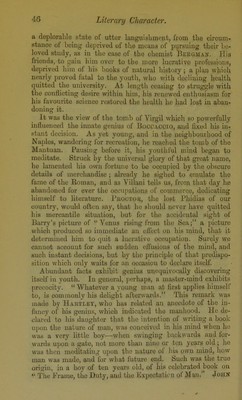
![a deplorable state of utter languishment, from the circum- stance of being deprived of the means of pursuing their be- loved study, as in the case of the chemist BEUGiiAU. His friends, to gain him over to the more lucrative professions, deprived him of his books of natural history; a plan which nearly proved fatal to the youth, who with declining health quitted the university. At length ceasing to struggle with tlie conflicting desire within him, his renewed enthusiasm for his favourite science restored the health he had lost in aban- doning it. It was the view of the tomb of Virgil which so powerfully influenced the innate genius of Boccaccio, and fixed his in- stant decision. As yet young, and in the neighbourhood of Naples, wandering for recreation, he reached the tomb of the Mantuan. Pausing before it, his youthful mind began to meditate. Struck by the universal glory of that gi-eat name, he lamented his own fortune to be occupied by the obscure details of merchandise; already he sighed to emulate the fame of the Roman, and as Villani tells us, from that day he abandoned for ever the occiqiations of commerce, dedicating himself to literature. Pnoexou, the lost Phidias of our countr}, would often say, that ho should never have quitted his mercantile situation, but for the accidental sight of Barry’s picture of “Venus rising from the Sea;” a picture which produced so immediate an efl'ect on his mind, that it determined him to quit a lucrative occujiation. Surely we cannot account for such sudden elfusions of the mind, and such instant decisions, but by the principle of that predispo- sition which only waits for an occasion to dechu’e itself. Abundant facts exhibit genius unequivocally discovering itself in youth. In general, jierhaps, a master-mind exhibits precocity. “ Whatever a young man at first applies himself to, is oommonly his delight afterwiU’ds.” This remark was made by Hahtlet, who has related an anecdote of the in- fancy of his genius, which indicated the manhood. He de- clared to bis daughter that the intention of writing a book u])on the nature of man, was conceived in his mind when he was a very little boy—when swinging backwards and for- wiirds upon a gate, not more than nine or ten years old; he was then meditating upon the nature of bis own mind, how man was made, and for what future end. Such was the true origin, in a boy of ten years old, of his celebrated book on “ The Frame, the Duty, and the Expectaticn of Man.” JouK](https://iiif.wellcomecollection.org/image/b24851590_0066.jp2/full/800%2C/0/default.jpg)

 No text description is available for this image
 No text description is available for this image
 No text description is available for this image