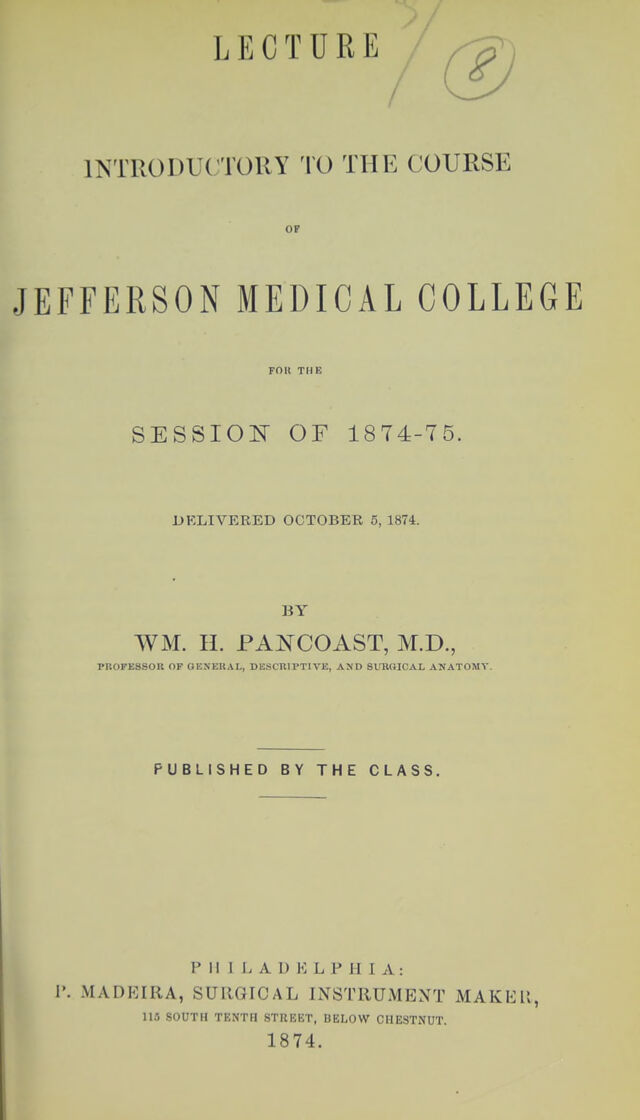
Lecture introductory to the course of Jefferson Medical College for the session of 1874-75 : delivered October 5, 1874 / by Wm. H. Pancoast.
- Pancoast, William Henry, 1834-1897.
- Date:
- 1874
Licence: Public Domain Mark
Credit: Lecture introductory to the course of Jefferson Medical College for the session of 1874-75 : delivered October 5, 1874 / by Wm. H. Pancoast. Source: Wellcome Collection.
Provider: This material has been provided by The Royal College of Surgeons of England. The original may be consulted at The Royal College of Surgeons of England.
16/30 page 12
![Fabriciiis of Aquapcndente, had taken up tlie subject with great enthusiasm. He opened up all the veins of the body, and described carefully the form, situation, and structure of the valves. He was not able, however, to grasp tlie great secret of tiie circulation. He taught at Padua. The very anatomical theatre in wiiicli lie lectured, is yet standing unchanged. It is a small funnel-shaped chamber, with higli circular walls, on tlie inside of which tliere is a smooth spiral staircase to the top, along whicii the students placed themselves standing, as they looked down upon the novel demonstrations of tlie distinguished teacher. To this school came the young Harvey, and in the adjoining hall hang his armorial bearings, among those of other noble, and worthy students of the University of Padua, whose names have been thus preserved to fame, for learning then was an honor. I have stood on that winding stair, where Harvey stood, and as I looked down upon the table below, I have tried to conjure up his brooding fancies, as looking along the course of the opened veins, he began to work out a complete view of the circulation, by adding to the venous, the torrent of the arterial circuit. On returning to Enf^land, he resumed with enthusiasm the study of the circulation. He is said to have opened animals alive, in order to determine more accuratelj', the uses of the valves. Finnll}', he dissected out the main trunks of the arteries and veins entire, and arranged them on a large blackboard, so as to make completely manifest to the eye, the true nature of the circulation. I have seen such a preparation, made it is said by his own hand, in the museum of the Roj^al College of Physicians and Surgeons in Loudon, where it is preserved as a simple, but precious relic. Soon after tlie establishment of Harvey's theory of the circu- lation, the vessels which carry merely the white fluids of the bod}'^— the lacteals and l3-mphatics—were made known more completely to science, by the labors of some able dissectors, Asselius of Pavia, Rudbeck a Swede, Bartholinus a Dane, Pecquet of France, Dr. Monro and Mr. Hewson of Great Britain—the last the grandfather of a dis- tinguished alumnus of our school; but ultimate]}'—in 1T8T—this important sj'stem was demonstrated by Mascagni, who was the first to give us a general description, of the entire lymphatic apparatus. About the middle of the sixteenth centurj'^, the microscope which had for some time been used, was improved and brought more fully into use, and was found to be a great acquisition, in the study of anatomy. To the instrument of that dny, we are indebted for many important discoveries in the minute structure of the parts—made by such men as Malpiglii, Swainmerdam, and Leeuwenhoek. In this way, and from a great variety of sources, that the hour this evening will](https://iiif.wellcomecollection.org/image/b22292810_0016.jp2/full/800%2C/0/default.jpg)