Malformations of the kidney, and displacements without mobility, with illustrative cases and specimens / by David Newman, M.D., Surgeon, Royal Infirmary, Glasgow.
- Newman, David, 1853-1924
- Date:
- [1898?]
Licence: Public Domain Mark
Credit: Malformations of the kidney, and displacements without mobility, with illustrative cases and specimens / by David Newman, M.D., Surgeon, Royal Infirmary, Glasgow. Source: Wellcome Collection.
Provider: This material has been provided by The University of Glasgow Library. The original may be consulted at The University of Glasgow Library.
34/49 (page 31)
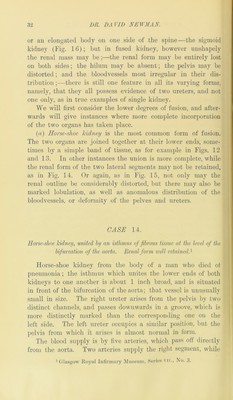
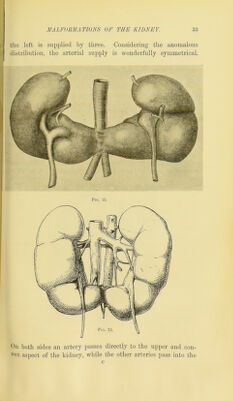
![2. Hypertrophy of one kidney. Hypertrophy of one kidney is not often met with independently of some condition which has produced a functional weakness of its fellow. Hypertrophy of both kidneys is, however, often seen in cases of diabetes insipidus, and perhaps also in diabetes mellitus. Enlargement of one kidney only may however occur in- dependently of any functional inactivity or structural defect of its neighbour. The kidney may go on increasing in size beyond the normal limit, just as we may have excess of growth in one limb, or undue growth of individual fingers, or toes, of the tongue, the larynx, or the lower jaw. CASE 13. Simple hypertrophy of the left kidney only, right kidney normal in size and appearance. At a post-mortem examination upon a man 36 years of age, who died from fracture of the skull, I found the right kidney to be normal in weight, 6| ounces, while the left weighed 10^ ounces. The man was of average height, and weighed 11] stones. Both kidneys, on microscopic examina- tion, were found to be typically healthy, with the exception of the histological elements of the left kidney which were uniformly enlarged, as has been observed in cases of com- pensatory hypertrophy. 3. Fusion of txoo kidneys. (a) Horse-shoe kidney; (b) sigmoid kidney; (c) disc-shaped kidney. The amount of fusion that takes place between two kidneys varies greatly. We may have the two organs united together across the vertebrae, at their lower extremities, by a narrow, thin, and flat isthmus, which may be formed of connective tissue only, as illustrated in Fig. 12, or the union may be made up of kidney parenchyma; these are the lowest grades of coalescence, and from these we meet with all degrees of fusion until we reach a condition where the two kidneys become completely incorporated in one another, so as to form either one disc- shaped organ (Fig. 17), generally situated in the middle line,](https://iiif.wellcomecollection.org/image/b24933971_0035.jp2/full/800%2C/0/default.jpg)