[Report 1952] / Medical Officer of Health and School Medical Officer of Health, East Riding of Yorkshire County Council.
- East Riding of Yorkshire (England). County Council
- Date:
- 1952
Licence: Attribution 4.0 International (CC BY 4.0)
Credit: [Report 1952] / Medical Officer of Health and School Medical Officer of Health, East Riding of Yorkshire County Council. Source: Wellcome Collection.
25/96 (page 21)
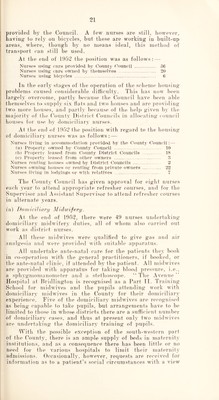
![[ provided by the Council. A few nurses are still, liowever, [ having* to rely on bicycles, but these are working in built-up 1 areas, where, thougli by no means ideal, this method of * transport can still be used. At the end of 1952 the position was as follows: — Nurses using* ear.s providerl by County Council ,36 Nurses using* ears owner! by tbeinselves 20 Nurses using* bicycles 6 In the early stages of the operation of the sclieme housing [ problems caused considerable (litficulty. This has now been largely overcome, partly because the Council have been able r themselves to sui)ply six flats and two lioiuses and are ])roviding t two more houses, and ])art]y because of the helj) given by the [' majority of tlie ('ounty l)isti*ict ('ouncils in allocating ( ouncil [ houses for use by domiciliai'v nurses, I At the end of 1952 the ]msition with regard to the housing li of domiciliary nurses was as follows: — I ' Nurses living in acconiinodation provideil by the County Council : — (a) Property owned by County Council 10 I (b» Property lea.sed from County District Councils IR I (c) Property leased from other owners 8 Nurses renting bouses owned by District Councils 2 Nurses owning houses or i*enting from private owners 22 Nurses living in lodgings or with relatives T The County Council has given approval for eight nurses each year to attend ap])ropriate refresher courses, and for the Supervisor and Assistant Su]jervisor to attend refresher courses : in alternate years, (a) Do m ic i 1 io ry .1/ idw if^Ty. At the end of 1952, there were 49 nurses undertaking domiciliary midwifery duties, all of whom also carried out work as district nurses. 1 All these midwives were (|ualified to give gas and air analgesia and weie ])rovided with suitable ap])'aratus. ^ All undertake ante-natal care for the patients they book in ('o-operation with the general practitioners, if booked, or the ante-natal clinic, if attended by the ])atient. All midwives are provided with apparatus for taking blood pressure, i.e., a s])'hygmoman()metei‘ and! a stethoscoi)e. The Avenue Hospital at Ib'idlington is re(‘ognised as a Part TI. Training School for midwives and the ])upils attending work with domiciliary mi'dwives in the County for their domiciliary experience. Five of the domiciliary midwives are recognised as being capable to take pupils, but arrangements have to be limited to those in whose districts there are a sufficient number of domiciliary cases, and thus at present only two mid wives are undertaking the domiciliary training of ]>u!iils. With the possible exception of the south-western part of the County, there is an ample supply of beds in maternity institutions, and as a consequence there has been little or no need for the various hospitals to limit their maternity admissions. Occasionally, however, requests are received for information as to a patient’s social circumstances with a view](https://iiif.wellcomecollection.org/image/b29185609_0027.jp2/full/800%2C/0/default.jpg)