[Report 1952] / Medical Officer of Health and School Medical Officer of Health, East Riding of Yorkshire County Council.
- East Riding of Yorkshire (England). County Council
- Date:
- 1952
Licence: Attribution 4.0 International (CC BY 4.0)
Credit: [Report 1952] / Medical Officer of Health and School Medical Officer of Health, East Riding of Yorkshire County Council. Source: Wellcome Collection.
58/96 (page 54)
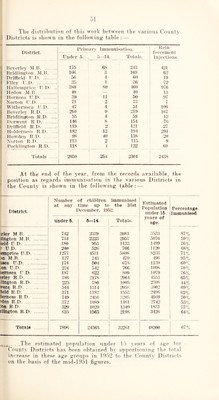
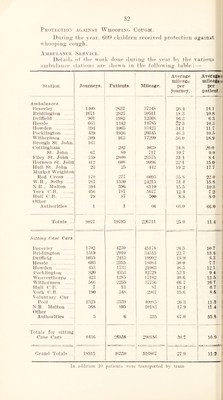
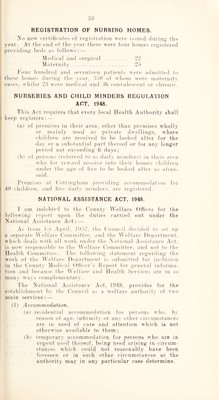
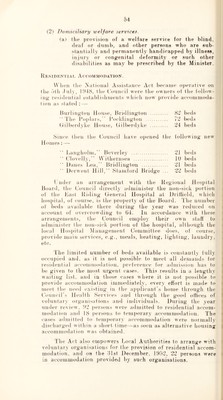
![(2) Domiciliary welfare services. (a) the provision of a welfare service for the blind, <leaf or dumb, and other persons who are sub- stantially and permanently handicapped by illness, injury or congenital deformity or such other rlisabilities as may be prescribed by the Minister. Re.SIDENTIAI. A( (OMMODATION. W hen the Nalioiral Assistance Act hecame operative on the 5th -InU, lt)48, the ('ouncil weie the owners of the follow- ing residential estahlishments uhiidi now provide a c com mo da- t ion as stated : —- llnrlington House, Bridlington 82 beds “'rio' Boplars,” Bocklling'ton 72 bods (lilberdvke House, tlilbeialvke 24 beds • I Since then the (-ouncil have ojieiied the following new H omes: — Hangholm, Beverley .. 21 beds (dovelly, W ithenisea 10 bods Danes Lea, ” Bridlington 21 beds Derwent Hill,” Stamford Bridge ... 22 beds 1. nder an arrangement with the Kegional Hospital Board, the Council directly administer the non-sick portion of the Last Riding (General Hospital at Dritiield, which hos[)i(al, of course, is the jiroimity of the Board. The number of beds available there during the year w^as reduced on account, of overcrowding to 04. in accordance with these arraiigoinents, the Coiiiiicil employ their own staff to administer the non-sick portion of the hospital, although the local Hospital .Management Committee does, of course, provide main services, e.g,, meals, heating, lighting, laundry, etc. The limitefl number of beds available is constantly fully o<;cu])ied and, as it is not possible to meet all demands for residential accoininodation, iindiu'cnce for adniission has to be given to the most urgent cases. This results in a lengthy waiting list, and in those cases where it is not possible to provide accominodatiun immediately, every effort is made to meet the need (>xisting in the ap|)licant’s home through the C'ouncirs Health Servi«'es and through the good otHces of voluntary <»iganisations and indivitluals. During the year under review. !)2 persons were admitted to residential accom- modation and 18 persons to temporary accommodation. The cases admitted to temporary accommodation were normally discharged within a short time—as soon as alternative housing accommodation was obtained. The Act also empowers Local Authorities to arrange with voluntary organisations for the provision of residential accom- modation, and on the tUst 4)ecember, 1952, 22 persons were in accommoJatiou provided by such organisations.](https://iiif.wellcomecollection.org/image/b29185609_0060.jp2/full/800%2C/0/default.jpg)