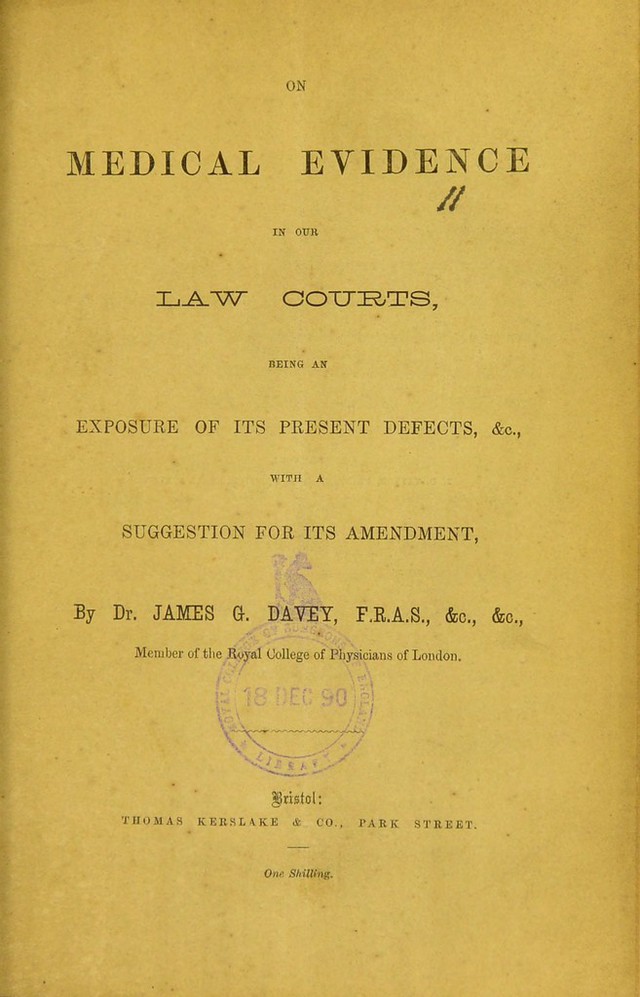
On medical evidence in our law courts : being an exposure of its present defects, &c., with a suggestion for its amendment / by James G. Davey.
- Davey, James George, 1813-1895
- Date:
- [1862]
Licence: Public Domain Mark
Credit: On medical evidence in our law courts : being an exposure of its present defects, &c., with a suggestion for its amendment / by James G. Davey. Source: Wellcome Collection.
Provider: This material has been provided by The Royal College of Surgeons of England. The original may be consulted at The Royal College of Surgeons of England.
10/30
![profession, being duly represented in a reformed, i. e., a more intellectual and less vicious legislature, shall demand to be heard in defence of its just claims on public consideration, not to say- gratitude ; and until then, but not much longer, shall we witness the present anomalous relative position of law and medicine, i. e., of lawyers and doctors. We have already shaken off the trammels of superstition, and have substituted facts and reasoning for idle fancies and priestly sophisjns : let us then pursue so commendable a course, and endeavour, through good and through evil report, to reach yet a higher stage of truth and independence. Let us look at the position of the ■ medical witness in our courts of law. Is the position assigned to him unobjectionable? Do his opinions and evidence receive that respect they are entitled to ? The following remarks refer to the subject of medical evidence, and are intended to prove that medico-legal matters have their abuses, and as such demand to be remedied. I shall endeavour, in the first place, to show that the practice now adopted of obtaining the testimony of medical men in cases of suspected lunacy, as well as in criminal matters, is throughout objectionable, and fraught with much mischief; and that the same is rather calculated to conceal the truth than to bring it to the surface. This much I shall endeavour to prove to you by reference to two very celebrated cases—one that of Mrs. Catherine Gumming ; the other of very* recent date—I mean the trial of William Palmer for the murder of John P. Cook. It is my purpose, in the second place, to suggest for your consideration a course of proceeding by which the objections at present existing may be avoided, and the medical witnesses escape the very anomalous and unfair position given to them as a body ; some of them being on the side of the prosecution, whilst others are on that of the defence—an arrangement, this, justified by custom certainly, but one calculated only, as it seems to me, to deprive them of the full force of whatever they may say, and not the less to deny to medical science its due weight and importance. A reference to the published report of the trial, in re Gumming, reveals the astounding fact of so many as twenty medical men appearing to give evidence ; that is to say, ten for the petitioners, and ten in opposition, or for ]\Irs. Gumming. Now, let us stop for one moment to mark the routine observed to enlist each one of such twenty medical](https://iiif.wellcomecollection.org/image/b22280029_0010.jp2/full/800%2C/0/default.jpg)