On the changes in the colour of the iris produced by inflammation / [James Hunter].
- Hunter, James, M.D.
- Date:
- 1841
Licence: Public Domain Mark
Credit: On the changes in the colour of the iris produced by inflammation / [James Hunter]. Source: Wellcome Collection.
3/6 page 81
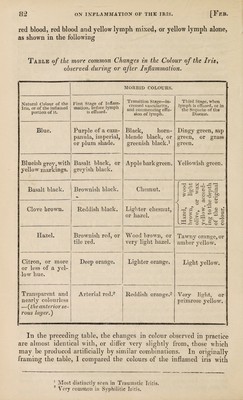
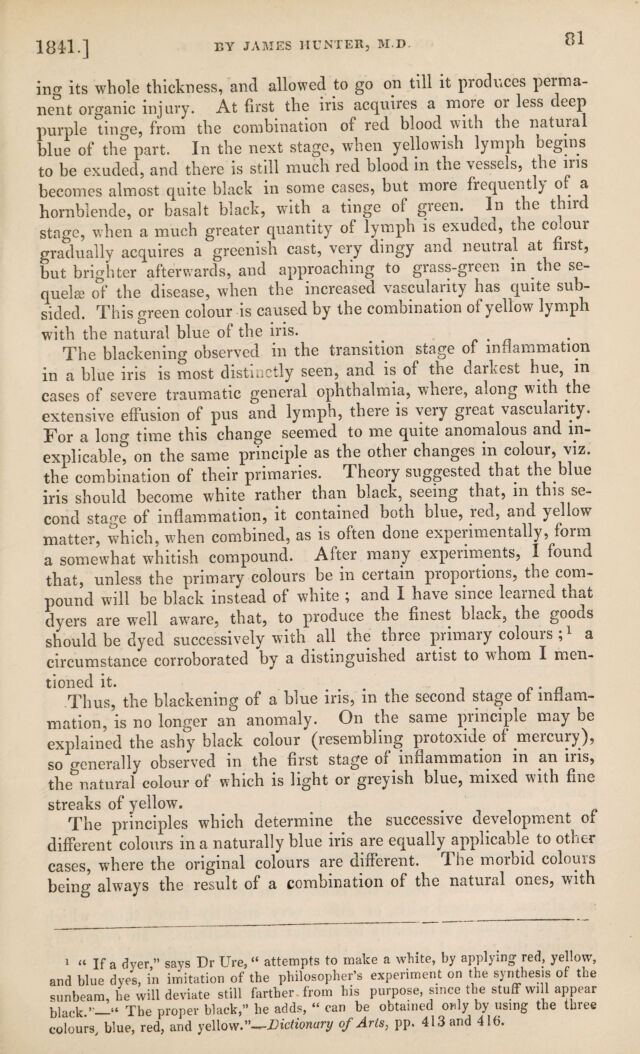
![184*1.] ■*»1 *'*■»**>» -? *- ino* its whole thickness, and allowed to go on till it pioduccs peima- nent organic injury. At first the iris acquires a moie or less deep purple tinge, from the combination of red blood with the natural blue of the part. In the next stage, when yellowish lymph begins to be exuded, and there is still much red blood in the vessels, the ins becomes almost quite black in some cases, but more frequentl) of a hornblende, or basalt black, with a tinge of green. In the t u stage, when a much greater quantity of lymph is exuded, tne colour gradually acquires a greenish cast, very dingy and neutral at fiist, but brighter afterwards, and approaching to grass-green in the se¬ quel* of the disease, when the increased vascularity has quite sun- sided. This green colour is caused by the combination of yellow lymph with the natural blue of the iris. . . The blackening observed in the transition stage of inflammation in a blue iris is most distinctly seen, and is of the darkest hue, in cases of severe traumatic general ophthalmia, where, along with the extensive effusion of pus and lymph, there is very great vascularity. For a long time this change seemed to me quite anomalous and in¬ explicable? on the same principle as the other changes in colour, viz. the combination of their primaries. Theory suggested that the blue iris should become white rather than black, seeing that, m this se¬ cond stage of inflammation, it contained both blue, led, and yellow matter, which, when combined, as is often done experimentally, form a somewhat whitish compound. After many experiments, I found that, unless the primary colours be in certain proportions, the com¬ pound will be black instead of white ; and I have since learned that dyers are well aware, that, to produce the finest black, the goods should be dyed successively with all the three primary colours a circumstance corroborated by a distinguished artist to whom I men¬ tioned it. Thus, the blackening of a blue iris, in the second stage of mfiam- mation, is no longer an anomaly. On the same principle may be explained the ashy black colour (resembling protoxide of mercury), so Generally observed in the first stage of inflammation in an ms, the natural colour of which is light or gieyish blue, mixed with fine streaks of yellow. The principles which determine the successive development of different colours in a naturally blue iris are equally applicable to other cases, where the original colours are different. The moibid colouis being always the result of a combination of the natural ones, with 1 “ If a dyer ” says Dr Ure, “ attempts to make a white, by applying red, yellow, and blue dyes, in imitation of the philosopher’s experiment on the synthesis of the sunbeam, he will deviate still farther from his purpose, since the stuff will appear black.’_“ The proper black,” be adds, “ can be obtained only by using the three colours, blue, red, and yellow.”—-Dictionary of Arts, pp. 413 and 416.](https://iiif.wellcomecollection.org/image/b30381800_0003.jp2/full/800%2C/0/default.jpg)