Normal histology : a manual for students and practitioners / by John R. Wathen.
- Wathen, John Roach, 1872-
- Date:
- [1905]
Licence: In copyright
Credit: Normal histology : a manual for students and practitioners / by John R. Wathen. Source: Wellcome Collection.
63/232
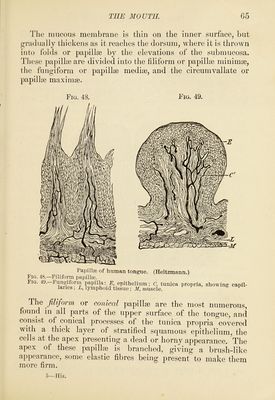
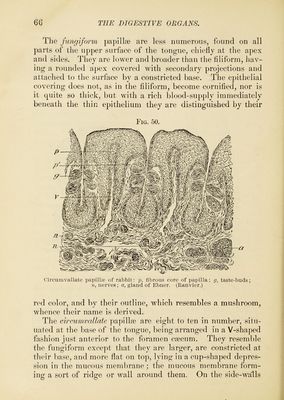
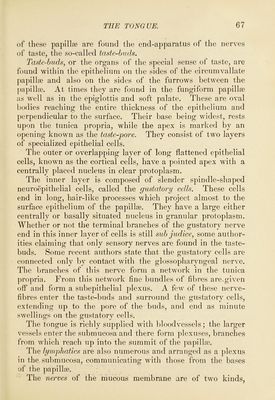
![of these papillfe are found tlie end-apparatus of the nerves of taste, the so-called taste-buds. Taste-buds, or the organs of the special sense of taste, are found within the epithelium on the sides of the circnmvallate papillae and also on the sides of the furrows between the pa])illje. At times they are found in the fungiform papilla) as well as in the epiglottis and soft palate. These are oval bodies reaching the entire thickness of the epithelium and perpendicular to the surface. Their base being widest, rests upon the tunica propria, while the apex is marked by an opening known as the taste-pore. They consist of two layers of specialized epithelial cells. The outer or overlapping layer of long flattened epithelial cells, known as the cortical cells, have a pointed apex with a centrally placed nucleus in clear protoplasm. The inner layer is composed of slender spindle-shaped neuroepithelial cells, called the gustatory cells. These cells end in long, hair-like processes which project almost to the surface epithelium of the papillae. They have a large either centrally or basally situated nucleus in granular protoplasm. Whether or not the terminal branches of the gustatory nerve end in this inner layer of cells is still sub judice, some author- ities claiming that only sensory nerves are found in the taste- buds. Some recent authors state that the gustatory cells are connected only by contact with the glossopharyngeal nerve. The branches of this nerve form a network in the tunica propria. From this network fine bundles of fil)res are.given off and form a subepithelial ])lexus. A few of these nerve- fibres enter the taste-buds and surround the gustatory cells, extending up to the pore of the buds, and end as minute swellings on the gustatory cells. The tongue is richly supplied with bloodvessels; the larger vessels enter the submucosa and there form plexuses, branches from which reach up into the summit of the papilla?. The lymphatics are also numerous and arranged as a plexus in the submucosa, communicating with those from the bases of the papillse. ' The nerves of the mucous membrane are of two kinds.](https://iiif.wellcomecollection.org/image/b2805801x_0063.jp2/full/800%2C/0/default.jpg)