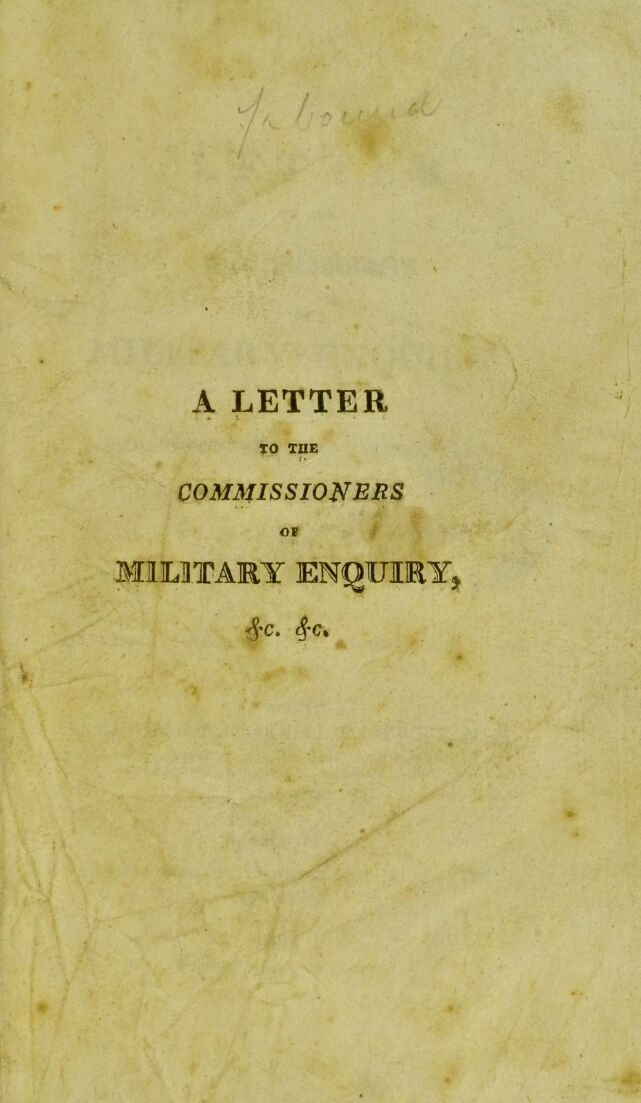
A letter to the Commissioners of Military Enquiry : containing animadversions on some parts of their fifth report ; and an examination of the principles on which the medical department of armies ought to be formed / by Edward Nathaniel Bancroft.
- Date:
- 1808
Licence: Public Domain Mark
Credit: A letter to the Commissioners of Military Enquiry : containing animadversions on some parts of their fifth report ; and an examination of the principles on which the medical department of armies ought to be formed / by Edward Nathaniel Bancroft. Source: Wellcome Collection.
Provider: This material has been provided by the Royal College of Physicians of Edinburgh. The original may be consulted at the Royal College of Physicians of Edinburgh.
77/110 page 71
![[ ] You flate, p. 86, that “the moft queftionable part of the fyftem of medical promotion, refpedls the appoint- ment of infpeflors, and deputy infpeftors, and princi- pal medical officers. Thofe valuable and important appointments are nut governed by any eftabliflied rule. The infpedlor-general under whofe patronage the two firft are, fays, that he always feledfs thofe officers from the ftaff or regimental furgeons ; yet, although the pay of the firft clafs is double that of the phyficians, and that of the fecond exceeds it by five (hillings per diem, no length of fervice is requifite to qualify them for the appointment. At the fame time, therefore, that the giving of thefe ranks and pay tends to degrade the rank of phyjician in the army^ it cannot be fuppofed to have operated as an inducement to gentlemen of ability to enter originally into the fervice, or to continue in it.’*—You add “ the only juftifiable ground, to which we have before alluded, for any of thefe appointments feems to have been the expediency oi fuperjeding the phyftcians in the general fuperintendance of the medical concerns of the army fervice, to which by their rank they would otherwife have been entitled ; becaufe, being taken from civil life, they could not but have wanted that knowledge which was requifite to the conduB of mill- tary hofpitals, and the management offck foldiers.” Some of the obfervations in thefe paflages are highly proper. There are others, however, which are, as I think, of a different defcription, and have manifeftly originated in deficient and erroneous information. That you may become fenfible of this, I will fliortly . ftate the refults of my reading and enquiries refpedling the opinions and practice which have prevailed in the Britifti army in regard to the exercife of thofe duties now committed to the officers, denominated infpedfors](https://iiif.wellcomecollection.org/image/b21928526_0079.jp2/full/800%2C/0/default.jpg)