Preparatory and after treatment in operative cases / by Herman A. Haubold ... with four hundred and twenty-nine illustrations.
- Haubold, Herman A. (Herman Arthur), 1867-1931
- Date:
- 1910
Licence: Public Domain Mark
Credit: Preparatory and after treatment in operative cases / by Herman A. Haubold ... with four hundred and twenty-nine illustrations. Source: Wellcome Collection.
Provider: This material has been provided by the Augustus C. Long Health Sciences Library at Columbia University and Columbia University Libraries/Information Services, through the Medical Heritage Library. The original may be consulted at the the Augustus C. Long Health Sciences Library at Columbia University and Columbia University.
621/690 (page 587)
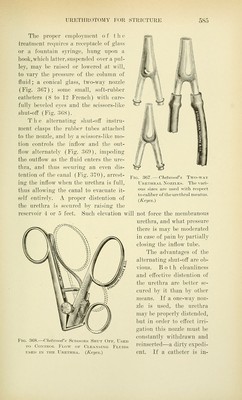
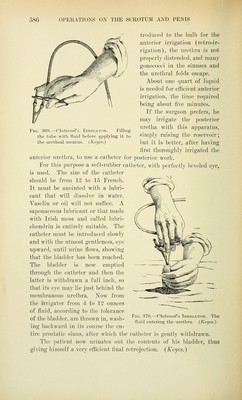
![In addition to this the patient should be given large quantities of water for several days before the operation, with the view of mechanically cleansing the urinary passages. When an external urethrotomy is made, the precautions men- tioned are all carried out, and the bladder is drained as is de- scribed under Perineal Prostatectomy (page 573). Sectioning of the urethra for stricture is, in a large number of instances, fol- lowed by a chill and rise of temperature which is transient and diseappears so rapidly that it is difficult to conceive the systemic disturbance as being due to sepsis. There is, perhaps, a peculiar relationship between trauma to the urethra and the toxemia which follows it. However, the fact that when cases are prepared in the manner stated the chill and rise of temperature does not, as a rule, obtain would suggest that there is some connection in this regard. For this reason a careful preparatory treatment along the lines mentioned is urged. When the operation is completed, the patient is placed in bed and artificial heat is applied in the manner described under Shock (page 227). As a routine thing a colic lavage of saline solution at a temperature of 110° P. is given at once, and this is repeated in six hours, irrespective of the occurrence of chill. Whether the presence of blood clots in the anterior urethra in cases of internal urethrotomy, or in a bladder after deep urethrotomy, has any- thing to do with the so-called urethral fever or not, it is, of course, difficult to say. However, this much is true, that febrile move- ment occurs less frequently as a complication later on (the second day), if the bladder drainage be perfect and the anterior urethra is lavaged with saline solution every twelve hours after the opera- tion. The question of whether sectioning of the urethra liberates into freshly traumatized tissue a certain number of bacteria which have been relatively isolated by protective exudates is also not quite clear. However, cleanliness and drainage, as indicated, seem rational procedures, and may be regarded as preventive meas- ures in this connection. The drain in the bladder is removed on the fourth day after the operation, and the umbrella packing is changed every twenty-four hours until this time. Following re- moval of the bladder drain the wound is dressed with gauze held in place with a T-bandage (Pig. 344). Urination now takes place for the most part through the perinea] opening. The](https://iiif.wellcomecollection.org/image/b21219503_0621.jp2/full/800%2C/0/default.jpg)