Volume 1
A course of lectures on natural philosophy and the mechanical arts / by Thomas Young.
- Thomas Young
- Date:
- 1845
Licence: Public Domain Mark
Credit: A course of lectures on natural philosophy and the mechanical arts / by Thomas Young. Source: Wellcome Collection.
Provider: This material has been provided by King’s College London. The original may be consulted at King’s College London.
15/670
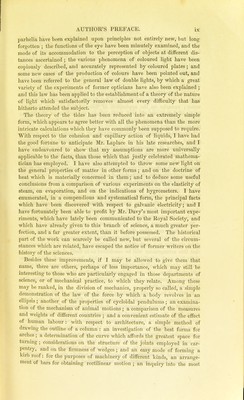
![parhelia have been explained upon principles not entirely new, hut long forgotten ; the functions of the eye have been minutely examined, and the mode of its accommodation to the perception of objects at different dis- tances ascertained; the various phenomena of coloured light have been copiously described, and accurately represented by coloured plates; and some new cases of the production of colours have been pointed out, and have been referred to the general law of double lights, by which a great variety of the experiments of former opticians have also been explained ; and this law has been applied to the establishment of a theory of the nature of light which satisfactorily removes almost every difficulty that has hitherto attended the subject. The theory of the tides has been reduced into an extremely simple form, which appears to agree better with all the phenomena than the more intricate calculations which they have commonly been supposed to require. With respect to the cohesion and capillary action of liquids, I have had the good fortune to anticipate Mr. Laplace in his late researches, and I have endeavoured to show that my assumptions are more universally applicable to the facts, than those which that justly celebrated mathema- tician has employed. I have also attempted to throw some new light on the general properties of matter in other forms; and on the doctrine of heat which is materially concerned in them; and to deduce some useful conclusions from a comparison of various experiments on the elasticity of steam, on evaporation, and on the indications of hygrometers. I have enumerated, in a compendious and systematical form, the principal facts which have been discovered with respect to galvanic electricity; and I have fortunately been able to profit by Mr. Davy’s most important expe- riments, which have lately been communicated to the Royal Society, and which have already given to this branch of science, a much greater per- fection, and a far greater extent, than it before possessed. The historical part of the work can scarcely be called new, but several of the circum- stances which are related, have escaped the notice of former writers on the history of the sciences. Besides these improvements, if I may be allowed to give them that name, there are others, perhaps of less importance, which may still be interesting to those who are particularly engaged in those departments of science, or of mechanical practice, to which they relate. Among these may be ranked, in the division of mechanics, properly so called, a simjde demonstration of the law of the force by which a body revolves in an ellipsis; another of the proi>erties of cycloidal penduhims; an examina- tion of the mechanism of animal motions; a compaiison of the measures and weights of different countries ; and a convenient estimate of the effect of human labour: with respect to architecture, a simple method of drawing the outline of a column : an investigation of the best forms for arches; a determination of the curve which affords the greatest space for turning; considerations on the structure of the joints em])loyed in car- pentry, and on the firmness of wedges; and an easy mode of fonning a kirb roof: for the j)urposes of machinery of different kinds, an arrange- ment of bars for obtaining rectilinear motion ; an inquiry into the most](https://iiif.wellcomecollection.org/image/b21301840_0001_0015.jp2/full/800%2C/0/default.jpg)




 No text description is available for this image
 No text description is available for this image
 No text description is available for this image