Volume 1
The New Sydenham Society̓s Lexicon of medicine and the allied sciences : (based on Mayne̓s Lexicon) / by Henry Power and Leonard W. Sedgwick.
- New Sydenham Society
- Date:
- 1881-1899
Licence: Public Domain Mark
Credit: The New Sydenham Society̓s Lexicon of medicine and the allied sciences : (based on Mayne̓s Lexicon) / by Henry Power and Leonard W. Sedgwick. Source: Wellcome Collection.
Provider: This material has been provided by The University of Leeds Library. The original may be consulted at The University of Leeds Library.
802/812
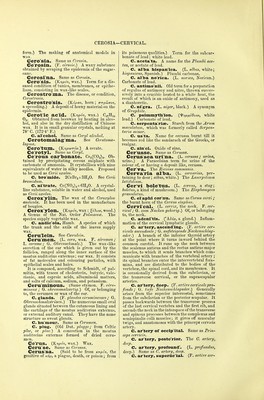
![CERECLOTH—CEREVISIA. akin to Gr. K&pa, the head; and Sans, ciras. F. cerveau ; I. cerebro, cervello ; S. cerebro, celebro ; G. Gehim.) The brain proper. In man, the largest and highest of the four parts into which the encephalic mass is usually divided ; it occu- pies the whole of the cavity of the cranium, with the exception of the middle and hinder basal portions, in which lie the other three divisions, the pons Varolii, the cerebellum, and the me- dulla oblongata. It varies in weight in the human species, the average being in the human male 43 oz. 15f drs., and in the female 38 oz. 12 drs., according to Reid; according to Weis- hach's observations, the average male brain weighs 1154-97 grammes, and bears a relation to the whole encephalon of 87'86 per cent.; and the female brain weighs 1038-90 grammes, and its percentage is 88-03. It is of ovoid shape, the small end foremost, flattened on its under surface, and divided into two symmetrical halves or hemi- spheres by the great longitudinal fissure, except in the middle third of the lower surface, where they are united by the corpus callosum ; smaller fissures divide it into five lobes, the frontal, pa- rietal, temporo-sphenoidal, occipital, and central; and still shallower clefts or furrows, the sulci, separate from each other the convolutions or gyri. It is closely invested by the pia mater, which transmits the blood-vessels, and is covered by the arachnoid epithelium. In the interior of each hemisphere is a branched flattened cavity, the lateral ventricle, with its three cornua, com- municating towards the anterior part of the body of the ventricle, by the foramen of Monro, with the third ventricle which lies centrally between the optic thalami, and which at its posterior ex- tremity is connected by means of the aquaeductus Sylvii with the fourth ventricle, a spear-shaped cavity lying between the medulla oblongata in front and the cerebellum behind. The cerebrum is composed of grey and white nervous tissue, the latter forming the main hulk of its interior, and arranged in groups of fibres, the former covering the exterior and collected into nodules of greater or less size in the substance of the white matter at the base. For further detail, see Brain ; B., development of, and the several parts of the cerebrum under their special names. C. abdomina'le. (L. abdominalis, be- longing to the abdomen.) The solar plexus. C, development of. See Brain, develop- ment of. C. elong-a'tum. (L. elongo, to lengthen.) A term for the Medulla oblongata. C, fi bres of. See Fibres, cerebral. C, fis sures of. See Fissures of cere- brum. C, lobes of. (Ao/3o9, a lobe. F. lobes du cerveau; G. Simlappcn.) The subdivisions of each hemisphere of the brain. They have been variously named; according to some they are three, anterior, middle, and posterior, or frontal, temporo-sphenoidal, and occipital; according to others, they are four, anterior, upper, lower, and the island of Reil; according to others they are five, frontal, parietal, occipital, temporo-sphe- noidal, and central. For further detail, see the several sections of Lobe. C. par'vum. (L. parvus, small.) The cerebellum. C, pe duncles of. (L. pedunculus, a little foot.) The Crura cerebri. C. poste'rius. (L. posterior, hinder.) The cerebellum. C, ventricles of. See Ventricles of cerebrum. Ce reclotll. (L. cero, to cover with wax; Sax. elath, a garment.) A linen or other cloth infiltrated with wax. C, antisep'tic. ('Akti', against; <n]7n-t- ko's, putrefying.) Calico or other material soaked in paraffin, wax, and carbolic acid, or other disinfectant. Used in the dressing of wounds. Cerec tomy. Same as Ceratectomy. Cerefo'lium. (Corrupted from Gharo- pliyllum.) The Anthriscus cerefolium. C. hispan'icum. (L. FLispania, Spain.) A name for the Myrrliis odorata, or sweet cicely. C. sylves'tre. The Anthriscus sylvcstris. Ce'reiform. (L. cereus, a wax taper; forma, shape.) Tapering, slender. Cerelse'um. (Y^npoi, wax; tkaiov, oil.) Old name (Gr. h^ptXaiov), used by Galen, de G. M. per Gen. 7, 2, for a cerate or liniment made of wax and oil; also called Oleum cerm and Butyr rum ceres. Cerenceph'alot. (K?ipo's, wax; iyntfy- a\os, the brain.) A synonym of Cephalot. Cere'oli. (L. cera, wax; oleum, oil. G. Wachskerzchen.) Bougies made by rolling strips of linen, soaked in wax and oil, into a pipe shape. C. antisep'tici- ('Avti, against; ai\Tni- koi, putrefying.) Same as G. carbolici. C. atropina'ti. Cereoli simplices, to each of which is added 01 to -02 gramme of atropin. Used for introduction into a mucous canal, such as the urethra, in painful affections. C. carbol'ici. Four parts of ceratum car- bolicum and one part of paraffin melted together and made into bougies, with a strip of linen, for insertion into the orifices of abscesses and into fistulous canals where there is a fcetid discharge. C. cum ac'ido tan'nico, Belg. Ph. Pre- pared with tannin, as G. cum opio. C. cum o'pio, Belg. Ph. (L. cera, wax; oleum, oil.) Extract of opium 20 centigrammes dissolved in 125 centigrammes of syrup, and gum acacia 300 centigrammes added. To be made into four suppositories. C. plum'bi. (L. plumbum, lead. G. Blei- kerzen.) Yellow wax 48 parts, spermaceti 1-5, and solution of basic acetate of lead 1 part; melted together, and made into a bougie with cotton wool. C. sim'plices. (L. simplex, simple.) Strips of linen soaked in a melted mixture of six parts of yellow wax and one of olive oil, and made into the form of a bougie. Used for ex- ploration and dilatation. Cere'olus. (L. dim. of cereus, a wax bougie.) A small wax bougie. Ce'reous. (L. cera.) Wax-like, made of wax. Cereris'ia. Same as Cerevisia. Cer'etrin. A term believed to be intended for cetrarin. Ge'reilSi (L. cera, wax; because made of wax. F. bougie; G. Wachsstock.) A wax bougie. C. medica'tus. (L. medieatus. medicinal. F. bougie medieamenteuse.) A medicated wax bougie. Ce reus. A Genus of the Nat. Order Cactacece. Cm, nig-ht bloom'ing-. The Cactus grandi- fiora. Cerevis'ia. A Gallic word; or, according](https://iiif.wellcomecollection.org/image/b21513685_0001_0802.jp2/full/800%2C/0/default.jpg)