A comprehensive medical dictionary : containing the pronunciation, etymology, and signification of the terms made use of in medicine and the kindred sciences.
- Joseph Thomas
- Date:
- 1865
Licence: Public Domain Mark
Credit: A comprehensive medical dictionary : containing the pronunciation, etymology, and signification of the terms made use of in medicine and the kindred sciences. Source: Wellcome Collection.
Provider: This material has been provided by the Harvey Cushing/John Hay Whitney Medical Library at Yale University, through the Medical Heritage Library. The original may be consulted at the Harvey Cushing/John Hay Whitney Medical Library at Yale University.
51/720 page 41
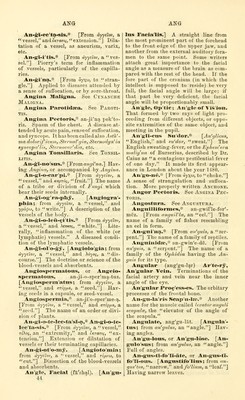
![plant -which affords the Cocculns Irtdicua fruit (Ed. Ph.). An-am-nes'tic. An-am-nos'ti-cal. [Anamnes'ticus; from dvafivfia<o), to recall to mind.] Recalling to memory. An-an'drous, or An-an'drl-ous. [Anan'der, or Anan'drius: from av, priv., and dvrjp, dv£p6$, a ''man, a '•male.] Applied to plants which have no male organs. Anaphrodisia,* an-af-ro-diz'e-a. [From av, priv., and dppociaia, things pertaining to Yenus.] Impotence; incapability of sexual intercourse, from whatever cause. An-a-plas'tic. [Anaplas'ticus.] Of or belonging to anaplasty. An'a-plas-tj'. [Anaplas'tia: from dvd, ••again, and xXdcrcru), to ''form or fashion.] Literally, forming anew. Surgical operations for the restoration of lost parts, or for the reparation of certain deformities or natural defects in the structure of the body. Aii-a-ple-ro'sis.:S [From dva-r\rip6cjf to fill again. to supply.] The sup- plement of parts destroyed, as in wounds, cicatrices, etc. An-a-ple-rot'ic. [Anaplerot'i- cus.] Belonging to anaplerosis; sup- plementary. An-a-sar'ea.* [From dvd, through, and ca^l, the flesh.] Dropsy in the integuments of the body. General dropsy, as distinguished from dropsy of some particular organ or part. An-a-stal'tie. [Anastal'ticns; from dvd, upwards. and oriWu, to set, send, contract.] Formerly applied to medicines that were styptic. An-as'to-mo'sis.* [From dvd, by, '• through. and orfya, a mouth.] The communication of branches of vessels i with each other. An-as-to-mot ic. [Anastomot'i- cns.] Of the nature of anastomosis. An-a-tom'I-cal. [Anatoni'icus.] Belonging to anatomy. A-nat'o-mist. [Fromdvd, through, up, and r£(ivoi, to cut.] A dissector of organized bodies, whether human, brute-animal (then called Zobtomist), or vegetable (then Phytotomist). A-nat'o-my. [Anato'mia; from the same.] Generally, the dissection of organized bodies, whether human, brute- animal, or vegetable. Anatomy. Ar-ti-nVial. [Anato'- mia Artificialis.] Imitated dissec- tions in wax, etc. Anatomy,Com-par'a-tive. [Ana- to'mia Comparati'va.] The dissec- tion of the lower animals, plants, etc., to illustrate those general principles of organizati'in which are common to an order, class, grand division, etc. Anatomy, I>e-scrip tive. [Ana- to'mia Wescripti'va.] Details of the situation, form, and relative attachments of the various parts. Anat'omy, Gen'e-ral. [Anato'mia CJenera'lis.] Description of the struc- ture and nature of the various tissues, apart from any consideration of the organs they compose. Anat'omy, Human. [Anato'mia Humana.] Dissection of man. Anat'omy, Med'i-cal. [Anato'mia >Ied'ica.] Embracing Descriptive, Phy- siological, and Pathological Anatomy. Anat'omy, Path-o-log'i-cal. [Ana- to'mia Patholog-'ica.] The investi- gation of changes in the structure of organs by disease, or from congenital malformation. Anat'omy, Phj's-I-o-log^i-cal. [Anato'mia Physiolog'ica.] The examination of the organs of animals to understand their respective functions in the healthy state. Anat'omy, Special. [Anato'mia Specia'lis.] Properly, the anatomy of a single species, as the anatomy of man, of the horse, etc.—Cruveilhier. In this sense it is contradistinguished from Comparative Anatomy; but, according to most writers, it is that branch of Anatomy which treats of the particular organs or parts (in a state of health) as contradistinguished from General Anato- my, which treats of the tissues, etc., common to the various organs. Anat'omy, Surg'I-caL [Anato'- mia Ohirur'giea.] The examination of the various organs, muscles, nerves, and blood-vessels, their precise situa- tion and relations to each other, with a special reference to surgery. Anat'omy, Tran-scen-den'tal. [Anato'mia Transcendentalis.] That branch of Anatomy which treats of the development of parts, their analo- gies, their primary model or type, ap- proximation to, or deviation from, that model; also termed Philosophical Anatomy. An-at'ro-pous. [Anat'ropus: from niarpfrrw, to subvert.] Applied in Botany to the ovule, in which the hilum and internal vmbilicus are opposed to each other. An-au'dl-a.s- [From av, priv., and](https://iiif.wellcomecollection.org/image/b21001388_0051.jp2/full/800%2C/0/default.jpg)
 No text description is available for this image
 No text description is available for this image
 No text description is available for this image