A comprehensive medical dictionary : containing the pronunciation, etymology, and signification of the terms made use of in medicine and the kindred sciences.
- Joseph Thomas
- Date:
- 1865
Licence: Public Domain Mark
Credit: A comprehensive medical dictionary : containing the pronunciation, etymology, and signification of the terms made use of in medicine and the kindred sciences. Source: Wellcome Collection.
Provider: This material has been provided by the Harvey Cushing/John Hay Whitney Medical Library at Yale University, through the Medical Heritage Library. The original may be consulted at the Harvey Cushing/John Hay Whitney Medical Library at Yale University.
52/720 page 42
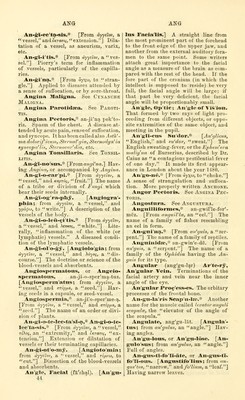
![avJij, speech.] Dumbness; privation of voice: catalepsy. An-a-zo-tu'ri-a.* [From av, priv., azo'tum, azote, and ovpov, urine.] A variety of chronic diuresis, in which there is a deficiency of urea. See Urea. An'ceps.* [From am, contraction of d(i(pi, on both sides, and ca'pio, to take, to compass.] Ancip'ital. Having the sides sharp like a two-edged sword. A term used in Botany. An'chi-lops.*' [From ay\i, near to, and ajip, the eye.] Supposed to be a stage of fistula lachrymalis before the inflamed swelling bursts; afterwards called xgilops. An'cno-ne.* [From ayxu, to stran- gle.] The sensation of strangling, in hysteria. An-cho-ra'lis.* [From an'chora, an anchor.] Applied to the coracoidpro- cess of the scapula. See Ancyroides. An-cnu'sa.:;: [From ayxco, to choke, to constringe the fauces.] A Linna?an genus of the class Pentandria, natural order Boraginese. Anchu'saTinc-to'ri-a.* [From tin'- go, tinc'tum, to dye.] Dyers' alkanet; a plant of the order Boraginacese, the root of which abounds in the red color- ing-matter called alkanet, used by dyers; also for imparting a deep red to oils, ointments, and plasters. Aiicliusin. an'ku-sin. [Anchusi'- na.] A red-colored principle obtained from Anchusa tinctoria, termed by some Anchusic acid. Anchylosis. See Ankylosis. Ancipitius,* an-se-pish'e-us. The same as Anceps. An'con.*' [From dy<wv, the elbow.] The elbow; the olecranon process of the ulna. An-co'nad. Applied the same as anconal used adverbially. An-co'nal. [Ancona'lis.] Belong- ing to the aneon. Applied by Dr. Bar- clay, of Edinburgh, in his proposed no- menclature, as meaning towards the ancon. Anconeus,* ang-ko-ne'iis, or an-ko'- ne-iis. [From ati'con.] Pertaining to the elbow. Formerly applied to various muscles attached to the olecranon; now limited to one. An'eo-noid. [Anconoi'dcs; from an'ron, and £160;, a form.] Resembling the aneon. Ancyloglossia. See Ankvloglossia. Ancylosis. See Ankylosis. An-^y-ro-i'des.* [From ayicvpa, an 42 anchor, and e7(5o?, a form.] Resem- bling an anchor. See Anchoralis. An-dra-nat'o-my. [Andranato - mia; from dvf\p, dvApos, a man, and di/aTCfii/o), to cut up.] Dissection of the human body, particularly the male. Androgynous, an-droj'e-nus. [An- drog-'ynus, or Androgyn'ius; from avijp, dv6p6i, a man, and yvvfj, a wo- man.] Partaking of both sexes; her- maphrodite. Android. [Androi'des: from dvrjp, a man, and eicoi, a form.] Resem- bling a man. An-dro-ma'ni-a.* [From dvfip, a man or 'male, and pavia, madness.] Same as Nymphomania or Furor uterinus. An-droph'o-rus.* [From dvf,p, a man or male, and <pipa), to bear.] The slender pillar which supports the united anthers in monadelphous and diadelphous plants. An-drot'o-my. [From dvvp, a man or male, and ripvoi, to cut.] The same as Andranatomy, which see. An'drum.* [Probably derived from and, a Hindoo word signifying tes- ticle.] A species of hydrocele, pecu- liar to the south of Asia, and described by Kseinpfer. An-el-lop'ter-us.*' [From uraX«j, to unroll, and -nrkpov, a wing.] Applied to insects with four wings, the two supe- rior of which are flexible: aneilop'terous. A-nel-la'ta,*or A-nel'li-des.* [From anel'lus, a little ring.] The fifth class of the Diploneura or Helminthoida, con- sisting of long, cylindrical, mostly aquatic worms, with red blood, covered with a soft and more or less segmented and an- nulated skin. The earth-worm belongs to this class. Also called Annelata, Annelida, and Axnelidans. Anemia. See Anemia. Anemic, Anemial. See An.emic, etc. An-e-mog'ra-phy. [Anemogra- pbia; from dvepo*;, wind, and ypd<pco, to write.] A description of the winds. An-e-mol'o-gy. [Anemolo'gia; from (iiepoi, the wind, and Xoyoj, a discourse.] The doctrine or science of the winds. An-e-mom'e-ter. [Anemom'e- triuii; from arcpos, the wind, and perpcu}, to measure.] An instrument for measuring the strength or velocity of the wind. An-e-mom'e-try. [Anemome'- tria; from the same.] The art of as- certaining the rapidity and direction of tho winds.](https://iiif.wellcomecollection.org/image/b21001388_0052.jp2/full/800%2C/0/default.jpg)
 No text description is available for this image
 No text description is available for this image
 No text description is available for this image