A comprehensive medical dictionary : containing the pronunciation, etymology, and signification of the terms made use of in medicine and the kindred sciences.
- Joseph Thomas
- Date:
- 1865
Licence: Public Domain Mark
Credit: A comprehensive medical dictionary : containing the pronunciation, etymology, and signification of the terms made use of in medicine and the kindred sciences. Source: Wellcome Collection.
Provider: This material has been provided by the Harvey Cushing/John Hay Whitney Medical Library at Yale University, through the Medical Heritage Library. The original may be consulted at the Harvey Cushing/John Hay Whitney Medical Library at Yale University.
58/720 page 48
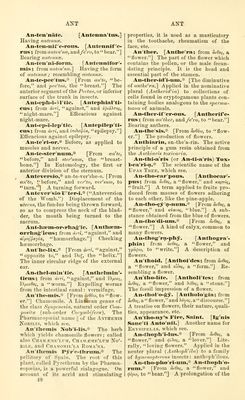
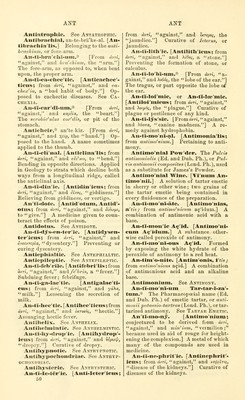
![An -ten 'n ate. [Antenna'tns.] Having anteimte. An-ten-nif'e-rons. [Antennif'e- rus; from dnten'na, and/Vro, to bear.] Bearing antennae. An-ten'iil-form. [Antennifor'- mis; from anten'na.] Having the form of antennse; resembling antennae. An-te-pec'tus.* [From an'te, be- fore, and pec'tus, the breast.] The anterior segment of the Pectus, or inferior surface of the trunk in insects. Ant-eph-i-al'tie. [Antephial'ti- cus; from dvri, against, and ed>ta\rrii, night-mare.] Efficacious against night-mare. Ant-ep-I-lep'tic. [Antepilep'ti- ens; from dvri, and tmXapia, epilepsy.] Efficacious against epilepsy. An-te'ri-or.* Before, as applied to muscles and nerves. Aii-te-ster'num.* [From an'te, before, and ster'num, the breast- bone.] In Entomology, the first or anterior division of the sternum. Anteversi©,* an-te-ver'she-o. [From an'te, before, and ver'to, ver'sum, to turn.] A turning forward. Antever'sioU'ter-i.* (Anteversion of the Womb.) Displacement of the uterus, the fundus being thrown forward, so as to compress the neck of the blad- der, the mouth being turned to the sacrum. Ant-hsem-or-rhag'ie. [Antbaem- orrhag'ieus; from dvri, against, and al/jtofpayia, haemorrhage.] Checking haemorrhage. Ant'he-lix.* [From dvri, against, opposite to, and cXi*, the helix.] The inner circular ridge of the external ear. An-thel-min'tie. [Anthelmin'- tieus; from dvri, against, and eXpuvs, eXptvdos, a worm.] Expelling worms from the intestinal canal: vermifuge. An'the-miK.-:- [From dv9ao, to flow- er.] Chamomile. A Linn«?an genus of the class Syngenesia, natural order Com- posite (sub-order Corymbifcrsr). The Pharmacopocial name || of the Axthemis Nobieis, which see. An'tnemis Nob'i-lis.* The herb which yields chamomile flowers ; called also Cham.emk'um, Cham^me'ltto No'- BILe, and Chamomil'la Roma'na. Au'lliesiita Pyr'e-thrnm.|: The pellitorv of Spain. The root of this plant, called Pyrethrum by the Pharma- copoeias, is a powerful sialagogue. On account of its acrid and stimulating 48 properties, it is used as a masticatory in the toothache, rheumatism of the face, etc. An ther. [Anthe'ra; from dv6o$, a flower.] The part of the flower which contains the pollen, or the male fecun- dating principle. It is the head and essential part of the stamen. An-ther-itVi-um.* [The diminutive of anthe'ra.'] Applied in the nominative plural (Antherid'ia) to collections of cells found in cryptogarnous plants con- taining bodies analogous to the sperma- tozoa of animals. An-ther-if 'er-ous. [Antherife- rus; from an'ther, and/e'ro, to bear.] Bearing anthers. An-the'sis.* [From avQiu, to flow- er.] The production of flowers. Anthiarin, an-the'a-rin. The active principle of a gum resin obtained from the Anthiaris toxicaria. An-thi-a'ris (or An-ti-a'ris) Tox- I-ea'ri-a.* The scientific name of the Upas Tree, which see. An-tho-ear'pous. [Anthoear'- pus; from diBog, a flower, and <cap7r6j, fruit.] A term applied to fruits pro- duced from masses of flowers adhering to each other, like the pine-apple. Aii-tho-cy'a-nmn.* [From avBog, a flower, and kvciios, blue.] A sub- stance obtained from the blue of flowers. An-tho'di-um.* [From aiOos, a flower.] A kind of calyx, common to many flowers. An-thog'ra-phy. [Anthogra'» phia; from iivdos, a flower, and ypd(po), to write.] A description of flowers. An'thoid. [Anthoi'des; from ui0o?, a flower, and elcos, a form.] Re- sembling a flower. An'tho-lite. [Antholi'tes; from dvOog, a flower, and \idog, a stone.] The fossil impression of a flower. An-thol'o-gy. [Antliolo'gia; from avQos, a flower, and Xoyog, a discourse.] A treatise on flowers, their nature, quali- ties, appearance, etc. An'tlio-ny's Fire, Saint. [Ig-'nis Sane'ti Anto'nii.] Another name for Erysipelas, which see. An-thoph'I-lus.* [From avBog, a flower, and <pi\ot, a lover.] Lite- rally, loving flowers. Applied in the neuter plural (Anthoph'ila) to a family of hymenopterou8 insects: anthoph'ilous. An-tho-plio'ri-uni,* An-tliopli'o- rum.:;:' [From dfOo;, a flower, and cpipo), to bear.] A prolongation of the](https://iiif.wellcomecollection.org/image/b21001388_0058.jp2/full/800%2C/0/default.jpg)
 No text description is available for this image
 No text description is available for this image
 No text description is available for this image