A comprehensive medical dictionary : containing the pronunciation, etymology, and signification of the terms made use of in medicine and the kindred sciences.
- Joseph Thomas
- Date:
- 1865
Licence: Public Domain Mark
Credit: A comprehensive medical dictionary : containing the pronunciation, etymology, and signification of the terms made use of in medicine and the kindred sciences. Source: Wellcome Collection.
Provider: This material has been provided by the Harvey Cushing/John Hay Whitney Medical Library at Yale University, through the Medical Heritage Library. The original may be consulted at the Harvey Cushing/John Hay Whitney Medical Library at Yale University.
78/720 page 68
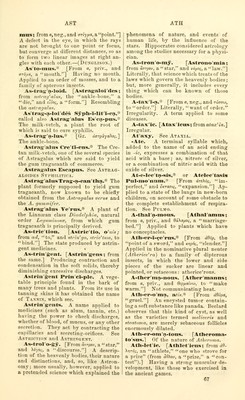
![At-Ian'tad. Same as Atlajjtal used adverbially. At-lan'tal. Applied by Dr. Bar- clay as meaning towards the atlas. At'las, an'/is* [From At'las, an ancient giant, fabled to bear the heavens upon his shoulders.] The first cervical vertebra, so named, it would seem, be- cause it immediately sustains the head, a burden immensely disproportioned to itself in size. At-ml-dom'e-ter, At-mom'e-ter. [Atniidom'etruiii, and Atmom'e- tiruin.] [From ar/ii'j, or drjioq, vapor, and nerpov, a measure.] An insti'u- ment by which the vapor exhaled from a humid surface in a given time may be measured. At'mo-sphere. [AtmosplaaVra; from dr/xog, vapor, and a^alpa, a globe or sphere.] The thin, elastic fluid encompassing the earth to a height judged to be about forty-five miles; the natural air we breathe. At-mo-spher'ic. [Atmospluer'i- ciis.] Belonging to the atmosphere. Atmosplier'ic Pres'sure, or weight of the atmosphere, is measured by the length of a column of mercury. A mer- curial column thirty inches in length presses on a given surface with the same force as the atmosphere in its ordinary state; and hence the force of a sixty- inch column is equal to the pressure of two atmospheres, that of fifteen inches to half an atmosphere, that of one inch to one-thirtieth of the atmospheric pres- sure. A-to'ci-a,* or A-to'Itl-a.* [From a, priv., and tokos, offspring.] Sterility. At'om. [At'om us; from a, neg., and rifjivcx), to cut, to divide.] The smallest particle of matter, incapable of farther division. Atom, Com-po'nent. That which unites with another of different nature to form a third or compound atom. At'om, Com'poimd. That formed by two atoms of different nature. Atom, El-e-mcn'ta-r^. That of a substnnce not decomposed. At'om. Or-jjan'ic. That of a sub- stance found only in organic bodies. At'om. Pri'ma-ry. Same as Atom, Elementary. At-om'ic. [Atom'icus.] Belong- ing to atoms or particles. Atom'ic TJie'o-ry. A theory intro- duced by Dalton for explaining the laws of definite proportions in chemical com- binations. It is founded on the sup- 68 position that matter consists of ultimate, indivisible particles, called atoms, that these are of the same size and shape in the same body, but differ in weight in different bodies, and that bodies com- bine in definite proportions with refer- ence to those weights, which are henco called atomic weights. The main features of this theory are briefly stated in the following paragraphs. In bodies capable of assuming the gaseous form, the weight of the atom is obtained from the volume: thus, water being composed of one volume of oxy- gen united with two volumes (or one atom) of hydrogen, the relative weights will be—oxygen, 8, hydrogen, 1, and water, 9. In bodies which do not assume the gaseous form in their simple state, the weight of the atom is deduced from that of the compound: the weight of carbon, for instance, is obtained from that of carbonic acid gas, one volume of which weighs twenty-two times as much as our standard of unity; of the twenty- two parts, sixteen are hydrogen, leaving 6 to represent the primary molecule of carbon. In. the case of bodies which are inca- pable of assuming a gaseous form, either alone or in combination, the weight must be obtained by analysis: thus, marble, or the carbonate of lime, is found to be composed of twenty-two parts of car- bonic acid and twenty-eight of lime; 28, therefore, represents the atomic weight of lime. The atomic weights are generally sup- posed to be related to one another by multiple: hence this law is often called the law of multiples, or of combinations in multiple proportion. This will be easily seen by referring to the component parts of the-following substances:— Nitrogen. Oxygen. Nitrous oxide 14 8 Nitric oxide 14 16 Hyponitrous acid 14 24 Nitrous acid 14 32 Nitric acid 14 40 When only one combination of any two elementary bodies exists, Dr. Dalton assumes that its elements are united, atom to atom singly, by what ho calls binary combinations; if several com- pounds can be obtained from the same elements, they combine, as he supposes, in proportions expressed by some simple multiple of the number of atoms, as in the following table:—](https://iiif.wellcomecollection.org/image/b21001388_0078.jp2/full/800%2C/0/default.jpg)
 No text description is available for this image
 No text description is available for this image
 No text description is available for this image