Manual of clinical diagnosis / by Otto Seifert and Friedrich Müller ; translated by William Buckingham Canfield.
- Otto Seifert
- Date:
- 1887
Licence: Public Domain Mark
Credit: Manual of clinical diagnosis / by Otto Seifert and Friedrich Müller ; translated by William Buckingham Canfield. Source: Wellcome Collection.
24/202 page 8
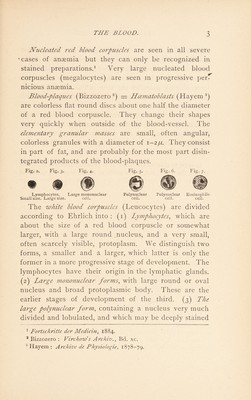
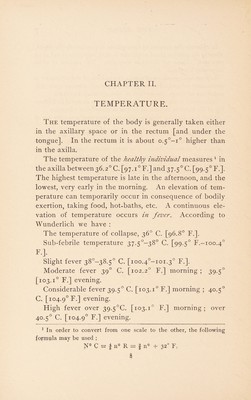
![TEMPERATURE. The temperature of the body is generally taken either in the axillary space or in the rectum [and under the tongue]. In the rectum it is about 0.50—1° higher than in the axilla. The temperature of the healthy individual measures 1 in the axilla between 36.2° C. [97. i° F.] and 37.50 C. [99.5°?.]. The highest temperature is late in the afternoon, and the lowest, very early in the morning. An elevation of tem¬ perature can temporarily occur in consequence of bodily exertion, taking food, hot-baths, etc. A continuous ele¬ vation of temperature occurs in fever. According to Wunderlich we have : The temperature of collapse, 36° C. [96.8° F.]. Sub-febrile temperature 37.5°-38° C. [99.5° F.-100.40 F.]. Slight fever 38°-38.5° C. [ioo.4°-ioi.3° F.]. Moderate fever 390 C. [102.20 F.] morning ; 39.50 [103.i° F.] evening. Considerable fever 39.50 C. [103.i° F.] morning ; 40.50 C. [io4.9°F.] evening. High fever over 39-5°C. [103.i° F.] morning; over 40.50 C. [104.90 F.] evening. 1 In order to convert from one scale to the other, the following formula may be used : N° C = I n° R = £ n° + 320 F. ft](https://iiif.wellcomecollection.org/image/b29323770_0024.jp2/full/800%2C/0/default.jpg)
 No text description is available for this image
 No text description is available for this image
 No text description is available for this image