Manual of clinical diagnosis / by Otto Seifert and Friedrich Müller ; translated by William Buckingham Canfield.
- Otto Seifert
- Date:
- 1887
Licence: Public Domain Mark
Credit: Manual of clinical diagnosis / by Otto Seifert and Friedrich Müller ; translated by William Buckingham Canfield. Source: Wellcome Collection.
34/202 page 18
![The circumference of the chest at the height of the nipple measures, in healthy men, 82.0 cm. [32J inches], after deep expiration, and 90 cm. [36 inches] after deep inspiration—that is to say, the maximum excursion of the thorax in respiration is 8.0 cm [3 inches]. In those who are right-handed, the circumference of the right half of the chest is 0.5 to 2.0 cm [J to 1 inch] larger than the left. In left-handed persons the left side is slightly larger. Enlargement of one or both sides of the chest is observed in pneumothorax, in effusions into the pleural sac (occasionally in pneu¬ monia), often in mediastinal tumors, and in emphysema. In the latter disease there is, in severe cases, a barrel-shaped chest, while all the diameters, but especially the sterno-vertebral diameter, are enlarged, so that there results a permanent position of inspiration. Enlargements, especially of the lower opening of the thorax, occur with tumors and effusions in the peritoneal cavity. A narrow thorax may be congenital or acquired. A congenital narrowing of the thorax, in which it is long, small, shallow, while the intercostal spaces are broad and the sterno-vertebral diameter is especially smaller, is called a paralytic shape of the thorax, and is most frequent in phthisis pulmonum. An acquired narrowing of the thorax may be caused by an ab¬ sorption of a pleuritic exudation and shrinkage of the lungs, as in phthisis and cirrhosis pulmonum. The member of respirations in the healthy adult is from 16 to 20, and in new-born children 44, a minute. The normal relation between the f requency of respiration and pulse is as 113 to 4. The inspiratory enlargement of the thorax takes place in the male, principally by a deep descent of the abdo¬ men, and partly by the raising of the ribs by the scaleni and intercostal muscles •— typus costo-abdominalis. In women, the inspiration is carried on more by raising the ribs—typus costalis.](https://iiif.wellcomecollection.org/image/b29323770_0034.jp2/full/800%2C/0/default.jpg)
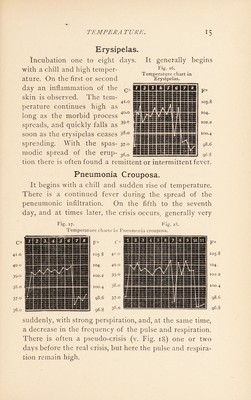
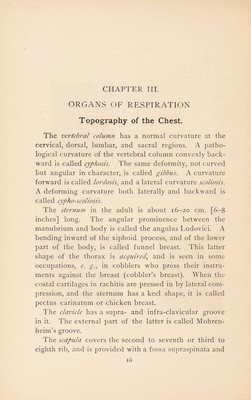
 No text description is available for this image
 No text description is available for this image
 No text description is available for this image