Second report of the Departmental Committee appointed to inquire into the ventilation of factories and workshops. Pt. 1, Report.
- Great Britain. Home Office. Committee on Ventilation of Factories and Workshops.
- Date:
- 1907
Licence: Public Domain Mark
Credit: Second report of the Departmental Committee appointed to inquire into the ventilation of factories and workshops. Pt. 1, Report. Source: Wellcome Collection.
37/140 (page 15)
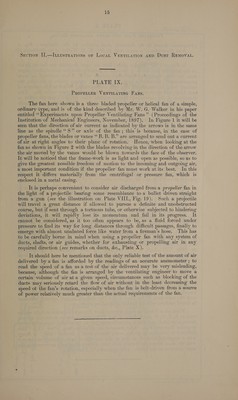
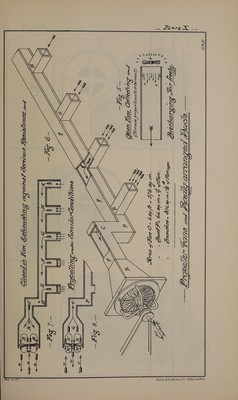
![Section I].—Iviustrations oF Locat VENTILATION AND Dust REMOVAL. Sriere ee PLATE IX. PROPELLER VENTILATING Fans. The fan here shown is a three bladed propeller or helical fan of a simple, ordinary type, and is of the kind described by Mr. W. G. Walker in his paper entitled ‘‘ Experiments upon Propeller Ventilating Fans” (Proceedings of the Institution of Mechanical Engineers, November, 1897). In Figure 1 it will be seen that the direction of air current as indicated by the arrows is in the same line as the spindle “5” or axle of the fan; this is because, in the case of propeller fans, the blades or vanes “ B. B. B.” are arranged to send out a current of air at right angles to their plane of rotation. Hence, when looking at the fan as shown in Figure 2 with the blades revolving in the direction of the arrow the air moved by the vanes would be blown towards the face of the observer. It will be noticed that the frame-work is as light and open as possible, so as to give the greatest possible freedom of motion to the incoming and outgoing air, a most important condition if the propeller fan must work at its best. In this respect it differs materially from the centrifugal or pressure fan, which is enclosed in a metal casing. It is perhaps convenient to consider air discharged from a propeller fan in the light of a projectile bearing some resemblance toa bullet driven straight from a gun (see the illustration on Plate VILL, Fig. 19). Such a projectile will travel a great distance if allowed to pursue a definite and unobstructed course, but if sent through a tortuous tube, or otherwise subjected to hindering deviations, it will rapidly lose its momentum and fail in its progress. It cannot be considered, as it too often appears to be, as a fluid forced under pressure to find its way for long distances through difficult passages, finally to emerge with almost unabated force like water from a fireman’s hose. This has to be carefully borne in mind when using a propeller fan with any system of ducts, shafts, or air guides, whether for exhausting or propelling air in any required direction (see remarks on ducts, &c., Plate X). It should here be mentioned that the only reliable test of the amount of air delivered by a fan is afforded by the readings of an accurate anemometer ; to read the speed of a fan as a test of the air delivered may be very misleading, because, although the fan is arranged by the ventilating engineer to move a certain volume of air at a given speed, circumstances such as blocking of the ducts may seriously retard the flow of air without in the least decreasing the speed of the fan’s rotation, especially when the fan is belt-driven from a source of power relatively much greater than the actual requirements of the fan. ae](https://iiif.wellcomecollection.org/image/b32182107_0037.jp2/full/800%2C/0/default.jpg)