Volume 1
Emery and Rimoin's principles and practice of medical genetics / edited by David L. Rimoin, J. Michael Connor, Reed E. Pyeritz.
- Date:
- 1996
Licence: Attribution-NonCommercial 4.0 International (CC BY-NC 4.0)
Credit: Emery and Rimoin's principles and practice of medical genetics / edited by David L. Rimoin, J. Michael Connor, Reed E. Pyeritz. Source: Wellcome Collection.
40/1784 (page 8)
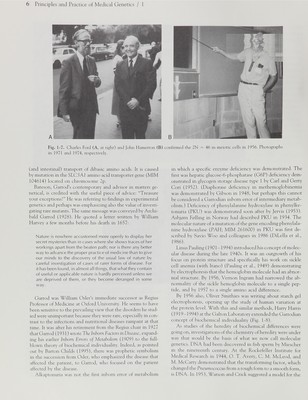
![Fig. 1-9. J. B. S. Haldane with Helen Spurway and Marcello Siniscalco at 2nd World Congress of Human Genetics, Rome, 1961. Corrections for these so-called biases of ascertainment were devised by Weinberg of the Hardy-Weinberg law, Bernstein of ABO fame, and Fritz Lenz and Lancelot Hogben, whose names are combined in the Lenz-Hogben correction, as well as by Fisher, Norman Bailey, and Newton E. Morton. With the development of methods for identifying the presence of the recessive gene biochemically and ultimately by analysis of the DNA itself, such corrections became less often necessary. Pre-1956 studies of genetic linkage in the human for the purpose of chromosome mapping are discussed later as part of a review of the history of that aspect of human genetics. GROWTH AND DEVELOPMENT OF MEDICAL GENETICS: 1956 TO THE PRESENT During the past 40 years, medical genetics has developed through a convergence of mendelism, cytogenetics, biochemi cal genetics, immunogenetics, and statistical, formal, and popu lation genetics. The development in each of these areas is traced in the preceding part of this chapter. Since 1956, medi cal genetics, in building on these foundations, has been blessed with three methodologies more or less specific to the field. These are “chromosomology” (beginning about 1956), somatic cell genetics (beginning about 1966), and molecular genetics (beginning about 1976). As will be indicated later, transgenic mice and all methods for transfer of genes into cultured cells or whole organisms, beginning about 1986, constitute a fourth methodologic approach. The gene transfer methods, in combi nation with directed mutation and gene “knock-out,” have already proved particularly useful in the analysis of the function of genes, normal and abnormal. Chr( Following the lead of Margery Shaw (personal comumcation, 1971), I divide the history of human cytogenetics into five ages: (1) 1882-1956 (gestation), the period from the first publi cation on human chromosomes to the reports of the correct chromosome number; (2) 1956-1966 (a golden age of human clinical cytogenetics); (3) 1966-1969 (resting phase), a period when the field seemed to be “in the doldrums,” with little progress; (4) 1969-1977 (the banding era); and (5) 1977 to the present (the era of molecular cytogenetics). Jerome Lejeune (1926-1994) (Fig. 1-10) opened up the field of clinical cytogenetics with his report in January 1959 of the extra small chromosome in mongoloid idiocy, as Down syn drome was then called. (A letter in The Lancet in 1961, contain ing a list of 19 signatories resembling a short who’s who in Human Genetics [Allen et ah, 1961], established the eponymic designation as the preferred one. This is a prime example of the triumph of an eponym.) The quinacrine fluorescence method was the first of the banding methods developed by Torbjpm Caspersson and col leagues (1970a,b, 1971) and exploited by Peter Pearson and others. This was followed by the various methods of Giemsa staining following alkali and other treatments for so-called G- banding, and by the method called reverse banding, or R-band- ing, because the Giemsa-light bands were stained. The banding techniques permitted the unique identification of each human chromosome. This was immensely useful in experimental situations such as the study of rodent/human so- Fig. 1-10. Jerome Lejeune in Baltimore, 1984.](https://iiif.wellcomecollection.org/image/b18037562_vol_1_0041.JP2/full/800%2C/0/default.jpg)