A text-book of diseases of the nose and throat / by D. Braden Kyle.
- Kyle, D. Braden (David Braden), 1863-1916
- Date:
- 1899
Licence: Public Domain Mark
Credit: A text-book of diseases of the nose and throat / by D. Braden Kyle. Source: Wellcome Collection.
621/680 (page 593)
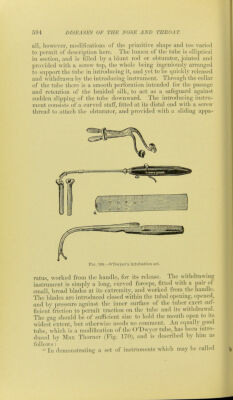
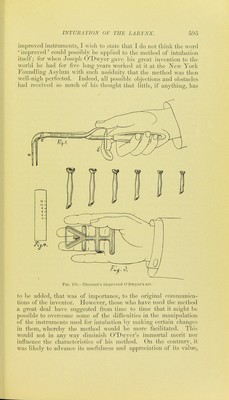
![larynx, other than <a glottic spasm. The difPerence between the indications for tracheotomy and for intubation is one largely of degree rather than kind. The operation naturally finds its great- est utility in the treatment of membranous occlusions, either local- ized within the larynx or extending into it from above. The dangers of edematous conditions caused by inhalation of irritant vapors, by the swallowing of irritant fluids, as the result of burns or scalds, or occurring in the exhibition of renal symptoms or other organic lesions, may ofttimes be averted by it without resort to tracheotomy. Certain slowly progressive stenotic condi- tions, as of specific cicatrization, may indicate it. If, however, the larynx be the seat of growths, benign or malignant, especially if, in the latter case, a laryngectomy is intended, or of morbid process requiring cessation of functional activity, the physiological rest of the organ had better be obtained by tracheotomy rather than by in- tubation. It is an operation suited to those of younger years, and, with equal indications for its performance, is to be preferred to tracheotomy when the latter must be performed through a short, fat, chubby neck. The operation is contra-indicated if the obstruc- tion is with reasonable certainty believed to be located or extend below the lower end of the intubation tube. Nor must eiforts at placing it in position be continued if more than a very moderate degree of force be necessary to pass it into or through the glottic chink. The operation is also contra-indicated during a spasm of the glottis. If, however, these occur in paroxysms, with remissions of sufficient length to permit it, intubation is most emphatically indicated during an interval. It is not an operation suited for the removal of foreign bodies. Instniments.—For this operation a special set of instruments and tubes is required, O'Dwyer's is preferable (Fig. 169). These comprise an introducing instrument, an extracting instrument for withdrawal of the tube, and a set of tubes with their proper gauge. In addition, a stout, self-retaining mouth-gag, some strong and fine braided silk, strips of rubber or adhesive plaster, open finger-stalls or a silk handkerchief for protection to the operator's fingers, and some sort of protective mask for the mouth and nose should be at hand. Sufficient instruments for the performance of a rapid tra- cheotomy should be held in readiness for any sudden emergency. The tubes are in sets and accompanied by a gauge denoting sizes for each age. In shape, the shaft of the tube may not inappropri- ately be likened to a spindle latei'ally compressed, with a medium symmetrical bulge and with the lower end cut square off and the edges rounded. The upper end is expanded into a flat collar, with bevelled upper surface to permit better relationshi]) witii the epi- glottis, and the edges are carefully rounded ; in short, the usual shape of the entire tube may be compared to an inverted hoof and foreleg of a horse, from the knee down, S[)ecial forms are made— 38](https://iiif.wellcomecollection.org/image/b20388469_0621.jp2/full/800%2C/0/default.jpg)