A text-book of diseases of the nose and throat / by D. Braden Kyle.
- Kyle, D. Braden (David Braden), 1863-1916
- Date:
- 1899
Licence: Public Domain Mark
Credit: A text-book of diseases of the nose and throat / by D. Braden Kyle. Source: Wellcome Collection.
632/680 (page 604)
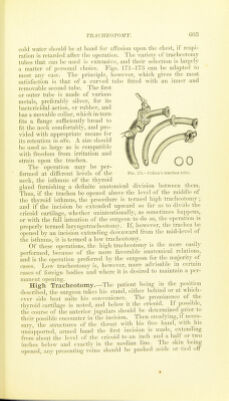
![and cut, the superficial fascia opened to the same extent upon the grooved director, and the deep fascia exposed. This is opened in the same manner and to the same extent, and the presenting veins, as before, are either pushed aside or tied off and cut. The inter- muscular interval between the sternohyoids and the sternothyroids is now located and carefully opened by a blunt dissector. This being done, the edges of the opening made so far must be kept carefully apart by means of blunt retractors reaching to the bottom of the wound. Too much care in placing and supporting these cannot be taken, both to avoid the very possible danger of mis- leading the surgeon's knife through a malplacement of the trachea and to minimize the amount of pressure upon it. The floor of the opening should now be formed by a layer of the deep cervical fascia, which in this region splits to enclose the thyroid isthmus, and more or less of the latter structure may be easily outlined or found bulging into the wound. The fascia is to be opened on a grooved director and the isthmus drawn downward by a blunt hook or small retractor. In case the isthmus fills too much of the wound to be so treated, a short transverse incision over the cricoid, not over one-half inch in length and through the fascia, may be made, and fascia and isthmus may be together stripped up and drawn downward.' A quantity of loose connective tissue just overlying the trachea must be cleai'ed carefully away and the cartilaginous rings plainly exposed. The trachea thus cleared, a tenaculum hook is fastened in the cricoid cartilage and held to steady the trachea. The knife is then to be so guarded by the forefinger as to prevent too deep a cut and posterior transfixion, and with its back to the sternum is to be inserted in the trachea above the isthmus in the middle line, while the two or thi^ee rings above it are to be opened by an upward cut. Care must be taken that, if a membrane be present in the trachea, it is opened also, lest it be forced downward by the knife. The opening made, there is usually more or less coughing, witl- ejaculation of bloody mucus and the like. This being cleared away, the edges of the wound are to be grasped with dissecting forceps and held open, or a dilator inserted for the same purpose, the trachea cleared, as far as possible, of mucus and noxious material, the tracheotomy tube inserted, the tenaculum removed, and the tube tied in by tapes passed around the neck and tied on one side. Suture of the wound below the tube may be performed. Or if the so-called operation without tubes be intended, blunt-retractor hooks are inserted and attached to the appropriate elastic neck-band necessary to keep the opening patulous; the edges of tlie cut arc sutured to the skin, or an oval or diamond-shaped i)ortion is removed, its long axis coin- cident with that of the trachea, according to which of these three methods the ojjerator ])refers. I/OW Tracheotomy,—Low tracheotomy requires practically](https://iiif.wellcomecollection.org/image/b20388469_0632.jp2/full/800%2C/0/default.jpg)