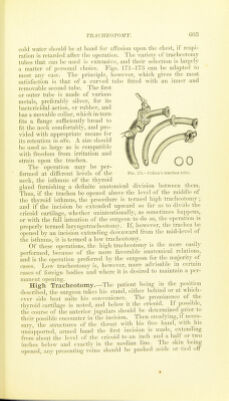
A text-book of diseases of the nose and throat / by D. Braden Kyle.
- Kyle, D. Braden (David Braden), 1863-1916
- Date:
- 1899
Licence: Public Domain Mark
Credit: A text-book of diseases of the nose and throat / by D. Braden Kyle. Source: Wellcome Collection.
635/680 (page 607)
![to heal by granulation. If, however, there is any reason to antici- pate, from the irritation of the operative measures employed or the condition present, a sudden edema of the laryngeal or glottic structures, a tube must be inserted, or the wound kept patent by the use of retractors and tapes until this danger is past. Anti- inflammatory drugs should be administered, cough quieted by some sedative mixture, and the patient kept quiet in the recum- bent position. Healing is usually fairly rapid, but care must be taken that drainage is free. The care of a patient in whom the opening is to be maintained, either by tubes or Avithout, is more complex. The room must be at an even temperature of between 75° and 80° F., without draughts, and the air must be moistened. This may be done either by boiling water and allowing the steam to permeate the air or by slacking lime in a suitable vessel. If necessary, a tent of sheets or of blankets may be constructed over the bed to confine the vapor better. Feeding is usually not dif- ficult. Rectal alimentation may in some cases be necessary, and at times the stomach-tube. Attention must be paid to the kidneys and bowels, and above all the insurance of sufficient sleep and rest must be obtained. Nor must the usual systemic and local treat- ment of the existent condition be discontinued after the operation. If a tracheotomy tube be used, the patient must be carefully watched and prevented from pulling it out, especially while com- ing out of ether, and afterward if he be not old enough to under- stand its use. A light piece of gauze or fine muslin is to be damp- ened and kept before the tube, as a strainer for dust. The tube must be kept clear, and this will require a varying amount of attention, according to the condition present. In croup, etc., the tube should be cleared at very frequent intervals, the tube being cleansed with an alkaline fluid and a feather. This may need to be done every half hour, and not infrequently the inner tube must be withdrawn for sudden blocking by a piece of detached mem- brane. The cannula should also be cleansed by an alkaline solu- tion, and must not be left too long without its inner tube. A bet- ter plan is to have two of the latter and use them alternately. In membranous cases, also, blocking may occur by a piece or roll of the membrane which cannot be removed through the tube, and may necessitate the withdrawal of the whole apparatus and the use of the tracheal dilator and the tracheal forceps—instruments which should be always at hand. The nurse should also be warned of this possibility and instructed how to withdraw it, remove, if neces- sary, the-impacted membrane, and keep the opening patulous by retractors until the surgeon arrives. The replacement of the tube before the wound has healed suflSciently to form a canal for it requires some skill ; but after the wound has so healed, about the third day, it is a eom])arativ('ly simple matter. Every_ two or three days the outer tube should be withdrawn, spots of discolora-](https://iiif.wellcomecollection.org/image/b20388469_0635.jp2/full/800%2C/0/default.jpg)