A text-book of diseases of the nose and throat / by D. Braden Kyle.
- Kyle, D. Braden (David Braden), 1863-1916
- Date:
- 1899
Licence: Public Domain Mark
Credit: A text-book of diseases of the nose and throat / by D. Braden Kyle. Source: Wellcome Collection.
641/680 (page 613)
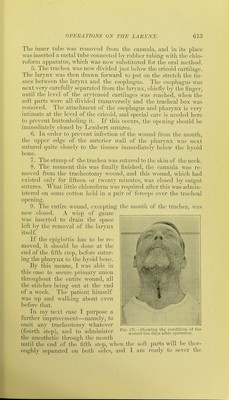
![The inuer tube was removed from the cannula, and in its place was inserted a metal tube connected by rubber tubing with the chlo- roform ap])aratus, which was now substituted for the oral method. 5. The trachea was now divided just below the cricoid cartilage. The larynx was then drawn forward to put on the stretch the tis- sues between the larynx and the esophagus. The esophagus was next very carefully separated from the larynx, chiefly by the finger, until the level of the arytenoid cartilages was reached, when the soft parts Avere all divided transversely and the tracheal box was removed. The attachment of the esophagus and pharynx is very intimate at the level of the cricoid, and special care is needed here to prevent buttonholing it. If this occurs, the opening should be immediately closed by Lerabert sutures. 6. In order to prevent infection of the wound from the mouth, the upper edge of the anterior wall of the pharynx was next sutured quite closely to the tissues immediately below the hyoid bone. 7. The stump of the trachea Avas sutured to the skin of the neck. 8. The moment this was finally finished, the cannula Avas re- moved from the tracheotomy Avound, and this wound, which had existed only for fifteen or tAventy minutes, was closed by catgut sutures. What little chloroform Avas required after this Avas admin- istered on some cotton held in a pair of forceps over the tracheal opening. 9. The entire AVOund, excepting the mouth of the trachea, was now closed. A Avisp of gauze Avas inserted to drain the space left by the removal of the larynx itself If the epiglottis has to be re- moved, it should be done at the end of the fifth step, before sutur- ing the phaiynx to the hyoid bone. By this means, I was able in this case to secure primary union throughout the entire Avound, all the stitches being out at the end of a Aveek. The patient himself Avas up and walking about even before that. In my next case I purpose a further improvement—namely, to omit any tracheotomy whatever (fourth step), and to administer the anesthetic through the mouth until the end of the fifth step, when the soft jjarts will be thor- oughly separated on both sides, and I am ready to sever the Fig. 175.—Showing Uie condition of Iho wound ten days ai'ler operation.](https://iiif.wellcomecollection.org/image/b20388469_0641.jp2/full/800%2C/0/default.jpg)