Copy 1
The principia; or, the first principles of natural things, being new attempts toward a philosophical explanation of the elementary world / By Emanuel Swedenborg ... Translated from the Latin by the Rev. Augustus Clissold.
- Emmanuel Swedenborg
- Date:
- 1845-1846
Licence: Public Domain Mark
Credit: The principia; or, the first principles of natural things, being new attempts toward a philosophical explanation of the elementary world / By Emanuel Swedenborg ... Translated from the Latin by the Rev. Augustus Clissold. Source: Wellcome Collection.
541/556 page 97
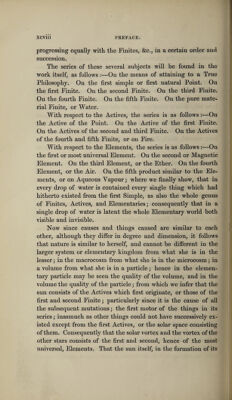
![a Simple, or from the first Finite, in succession to the fifth Finite. These five Finites have a mutual relation to each other, i are similar to each other, and differ only in degree and dimen¬ sion, or in their ratio to each other according as they are raised to successively higher powers or degrees. Again ; inasmuch as ; all Finites’ are capable of becoming Actives, or of performing gyres from a like inhering and concomitant force or cause, that is to say, from a spiral motion of the parts; and inasmuch as they can pass also into a Local motion, provided there be space and nothing in it to present any obstacle; it follows of course, that there^may be a fivefold series of Actives; an Active of the first, second, third, fourth, and fifth Finite points respectively; and hence that by means of the last or fifth Active, the fire of our system may pass into our atmosphere. The same law ob¬ tains in regard to the compounds or Elementary particles; which I hold to consist of two principles, namely. Actives and Finites; the Finites occupying the surface, the Actives occupy- ( ing the interiors. And inasmuch as there is thus a series of Finites and of Actives, there will also be a series of Elements such as the first or most universal Element, the second or Mag¬ netic or vortical Element, the third or Ethereal Element, the , fourth or Aerial Element; before the elementary kingdom be- i; longing to the world has yet been fully completed. And since I every single particle of each Element is elastic, encloses Ac- ‘ tives, and possesses the faculty \yi] of passivity and activity; ; hence the first Element encloses within it the Actives of the first Finite; the second, the Actives both of the first and se- \ cond ; the third, the first Elementary particles ; the fourth, both I the first and second Elementary particles; the two latter Ele- : ments participating in each principle, although they enclose not i real Actives but Elementary particles. For the Elementary I particles are not only passive but active; they are consequently ' elastic, and are moveable in particles and volumes; the motion and mechanism of their volume depending upon the motion and mechanism of their particles ; although they are not mobile and 1 elastic in the same degree as the enclosed first and second Ele¬ mentary particles from which they receive their elasticity. Thus we shew that the Elements also differ in degrees and dimension.](https://iiif.wellcomecollection.org/image/b29324919_0002_0541.jp2/full/800%2C/0/default.jpg)