The principles and practice of modern surgery / by Roswell Park ... with 722 engravings and 60 full-page plates in colors and monochrome.
- Roswell Park
- Date:
- 1907
Licence: Public Domain Mark
Credit: The principles and practice of modern surgery / by Roswell Park ... with 722 engravings and 60 full-page plates in colors and monochrome. Source: Wellcome Collection.
Provider: This material has been provided by the Augustus C. Long Health Sciences Library at Columbia University and Columbia University Libraries/Information Services, through the Medical Heritage Library. The original may be consulted at the the Augustus C. Long Health Sciences Library at Columbia University and Columbia University.
1159/1200
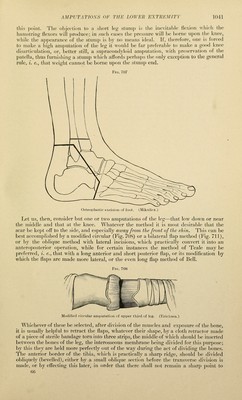
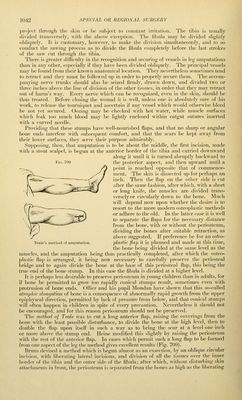
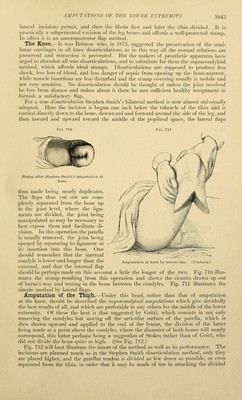
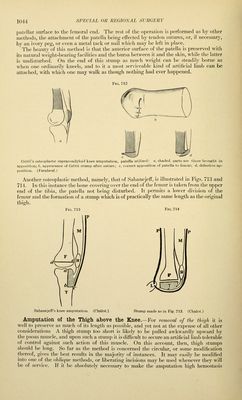
![this point. Tlir ohjcction to a short Ic^ stuiii|) is the iiifvitahU' flexion wliicii the hanis(rini>; flrxors will produce; in such cases the ])ressurc will he borne upon the knee, while the appearance of the stuinj) is by no means ideal. If, therefore, one is forced to make a hi<;h umputation of the leg it would be far preferable to make a good knee disarticulation, or, j)etter still, a supracondyloid amputation, with preservation of the patella, thus furnishing a stump which affords j)erhaps the only exception to the general rule, i. c, that wiMght cannot be borne upon the stum}) end. Fig. 707 Osteoplastic excision of foot. (Mikulicz.) Let us, then, consider but one or two amputations of the leg—that low down or near the middle and that at the knee. Whatever the method it is most desirable that the scar be kept off to the side, and especially away from ihe front of the shin. This can be best accomplished by a modified circular (Fig. 708) or a bilateral flap method (Fig. 711), or by the oblique method with lateral incisions, which practically convert it into an anteroposterior operation, while for certain instances the method of Teale may be preferred, i. e., that with a long anterior and short posterior flap, or its modification by which the flaps are made more lateral, or the even long flap method of Bell. Fig. 708 Modified circular amputation of upper third of leg. (Ericlisen.) Whichever of these be selected, after division of the muscles and exposure of the bone, it is usually helpful to retract the flaps, whatever their shape, by a cloth retractor made of a piece of sterile bandage torn into three strips, the middle of which should be inserted between the bones of the leg, the interosseous membrane being divided for this purpose; by this they are held more perfectly out of the way during the act of dividing the bones. The anterior border of the tibia, which is practically a sharp ridge, should be divided obliquely (bevelled), either by a small oblique section before the transverse division is made, or by effecting this later, in order that there shall not remain a sharp point to 66](https://iiif.wellcomecollection.org/image/b21211176_1159.jp2/full/800%2C/0/default.jpg)