The principles and practice of modern surgery / by Roswell Park ... with 722 engravings and 60 full-page plates in colors and monochrome.
- Roswell Park
- Date:
- 1907
Licence: Public Domain Mark
Credit: The principles and practice of modern surgery / by Roswell Park ... with 722 engravings and 60 full-page plates in colors and monochrome. Source: Wellcome Collection.
Provider: This material has been provided by the Augustus C. Long Health Sciences Library at Columbia University and Columbia University Libraries/Information Services, through the Medical Heritage Library. The original may be consulted at the the Augustus C. Long Health Sciences Library at Columbia University and Columbia University.
1160/1200
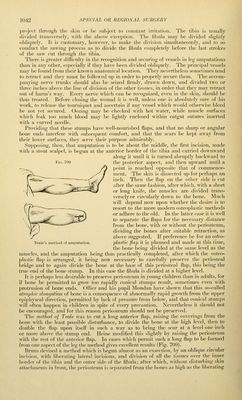
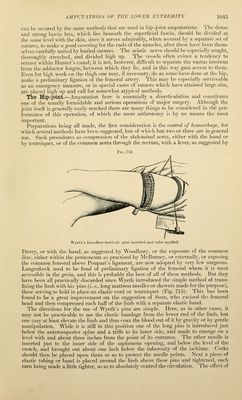
![Fig. 709 ])r()jcct tliroutijh the skin or he subject to constiuit irritation. The tibia is usually (Hvided transversely, with the above exee})tion. The fibula may be divided slightly obliquely. It is eustoniary, however, to make the division simultaneously, and to so conduct the sawing process as to divide the fibula completely before the last strokes of the saw cut through the tibia. There is greater difficulty in the recognition and securing of vessels in leg amjiutations than in any other, especially if they have been divided obliquely. The principal vessels may be found from their known anatomical location. They nevertheless sometimes tend to retract and they must be followed up in order to properly secure them. The accom- panying nerve trunks should also be seized firmly, drawn down, and divided two or three inches above the line of division of the other tissues, in order that they may retract out of harm's way. Every nerve which can be recognized, even in the skin, should be thus treated. Before closing the wound it is well, unless one is absolutely sure of his w^ork, to release the tourniquet and ascertain if any vessel which would otherwise bleed be not yet secured. Oozing may be checked w'ith hot water, wdiile muscle surfaces which leak too much blood may be lightly enclosed within catgut sutures inserted with a curved needle. Providing that these stumps have well-nourished flaps, and that no sharp or angular bone ends interfere with subsequent comfort, and that the scars be kept away from their lower surfaces, they serve their purpose admirably. Su]:>posing, then, that amputation is to l)e about the middle, the first incision, made with a stout scalpel, is begun at the anterior border of the tibia and carried downward along it until it is turned abruptly backward to the posterior aspect, and then upward until a point is reached opposite that of commence- ment. The skin is dissected up for perhaps an inch. Then the flap on the other side is cut after the same fashion, after which, wnth a short or long knife, the muscles are divided trans- versely or circularly down to the bone. Much will depend now upon whether the desire is to resort to the more modern osteoplastic methods or adhere to the old. In the latter case it is well to separate the flaps for the necessary distance from the bone, w ith or without the periosteum, dividing the bones after suitable retraction, as above suggested. If preference be for an osteo- plastic flap it is planned and made at this time, the l)one being divided at the same level as the muscles, and the amputation being thus practically completed, after which the osteo- plastic flaj) is arranged, it being now necessary to carefully preserve the periosteal bridge and to again divide the bone at the base of this ]:)eriosteal flap, this being the true end of the bone stump. In this case the fibula is divided at a higher level. It is perhaps less desirable to preserve periosteum in young children than in adults, for if bone be permitted to grow^ too rapidly conical stumps result, sometimes even with protrusion of bone ends. Oilier and his pupil Mondan have shown that this so-called atrophic elo7ir/ation of bone is a consequence of abnormally rapid grow^th from the upper e))iphyseal direction, ])ermitted by lack of pressure from below, and that conical stumps will often happen in children in spite of every precaution. Nevertheless it should not be encouraged, and for this reason periosteum should not be preserved. The method of Teale was to cut a long anterior flap, raising the coverings from the bone w^ith the least possible disturbance, to divide the bone at the high level, then to double the flap upon itself in such a w\ay as to bring the scar at a level one inch or more above the stump end. Heine modified this slightly by raising the periosteum with the rest of the anterior flap. In cases which permit such a long flap to be formed from one aspect of the leg the method gives excellent results (Fig. 709). Bruns devised a method which is begun almost as an exsection, by an oblique circular incision, with liberating lateral incisions, and division of all the tissues over the inner border of the til)ia and the outer side of the fibula; after which, without disturbing skin attachments in front, the [jeriosteum is sejiarated from the bones as high as the liberating Teale's method of amputation.](https://iiif.wellcomecollection.org/image/b21211176_1160.jp2/full/800%2C/0/default.jpg)