The principles and practice of modern surgery / by Roswell Park ... with 722 engravings and 60 full-page plates in colors and monochrome.
- Roswell Park
- Date:
- 1907
Licence: Public Domain Mark
Credit: The principles and practice of modern surgery / by Roswell Park ... with 722 engravings and 60 full-page plates in colors and monochrome. Source: Wellcome Collection.
Provider: This material has been provided by the Augustus C. Long Health Sciences Library at Columbia University and Columbia University Libraries/Information Services, through the Medical Heritage Library. The original may be consulted at the the Augustus C. Long Health Sciences Library at Columbia University and Columbia University.
1163/1200
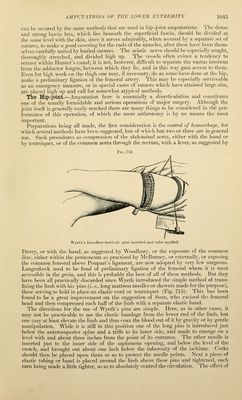
![can l)o secured 1)V the saiiu methods that are used in hi|)-ji)iut amputations. The dense and strorif,' faseia hita, whieli lies beneath the superlieiai laseia, should he divided at the same level with the skin, since it serves admirably, when secured by a separate set of sutures, to make a <jood covering]; for the ends of the muscles, after these have been them- selves carefully united by buried sutures. The sciatic nerve should be especially sou>;ht, thorou«;hly stretched, and divided hi^rh up. The vessels often evince a tendency to retract within Hunter's canal; it is not, however, difficult to separate the vastus internus from tlie adductor lon«jus, between wdiich they lie, and in this way gain access to them. Kven for hiuh work on the thiii;li one may, if necessary, do as some have done at the hij), make a ])reliminary ligation of the femoral artery. This may be especially serviceable as an enuT<'-ency measure, or in special cases of tumors which have attained large size, are placed Iiigh uj) and call for somewhat aty})ical methods. Tne Hip-30int.—Amputation here is essentially a dimriiculation and constitutes one of the usually formidable and serious operations of major surgery. Although the joint itself is generally easily reached there are many things to be considered in the {)er- formance of this operation, of which the mere arthrotomy is by no means the most important. I'reparations being all made, the first consideration is the control of hemorrhage, for which several methods have been suggested, but of which but two or three are in general use. Such procedures as compression of the abdominal aorta, either w^ith the hand or by tourniquet, or of tlie common aorta through the rectum, with a lever, as suggested by Fig. 715 Wyeth's bloodless method: pins inserted and tube applied. Davey, or with the hand, as suggested by Woodbury, or the exposure of the common iliac, either within the peritoneum as practised by McBurney, or externally, or exposing the common femoral above Poupart's ligament, are now adopted by very few surgeons. Langenbeck used to be fond of preliminary ligation of the femoral where it is most accessible in the groin, and this is probably the best of all of these methods. But they have been all practically discarded since Wyeth introduced the simple method of trans- fixing the limb with his pins (i. e., long mattress needles or skewers made for the purpose), these serving to hold in place an elastic cord or tourniquet (Fig. 715). This has been found to be a great improvement on the suggestion of Senn, who excised the femoral head and then compressed each half of the limb with a separate elastic band. The directions for the use of Wyeth's pins are simple. Here, as in other cases, it may not be practicable to use the elastic bandage from the lower end of the limb, but one may at least elevate the limb and thus coax the blood out of it by gravity or by gentle manipulation. While it is still in this position one of the long pins is introduced just below the anterosuperior spine and a trifle to its inner side, and made to emerge on a level with and about three inches from the point of its entrance. The other needle is inserted just to the inner side of the saphenous opening, and below^ the level of the crotch, and brought out about one inch below the tuberosity of the ischium. Corks should then be placed upon them so as to protect the needle points. Next a piece of elastic tubing or band is placed around the limb above these pins and tightened, each turn being made a little tighter, so as to absolutely control the circulation. The effect of](https://iiif.wellcomecollection.org/image/b21211176_1163.jp2/full/800%2C/0/default.jpg)